

Eagle Eye stone is a captivating gemstone known for its unique chatoyancy and metaphysical properties. This article explores everything you need to know about Eagle Eye stone and its close relative, Hawk's Eye stone—including their properties, meanings, uses, and more. Whether you are a gemstone enthusiast, jewelry maker, or spiritual practitioner, this guide will help you understand why Eagle Eye stone matters and how it can enhance your collection, jewelry designs, or spiritual practices.
We will cover the physical and metaphysical properties of Eagle Eye stone, its value in lithotherapy, its unique appearance and durability, and its significance as a talisman for courage, mental clarity, and emotional balance. You’ll also learn about its association with the third eye chakra, its effectiveness for calming emotional turmoil, cleansing the aura, and inspiring positive change. By the end, you’ll know how to care for these stones, spot fakes, and choose the right stone for your needs.
When it comes to captivating stones, tiger’s eye is among the most widely known for its chatoyancy. However, don’t overlook hawk’s eye and eagle’s eye. While the stones share some physical characteristics and have similar names, they’re not the same gem. All three—Eagle Eye, Hawk's Eye, and Tiger's Eye—belong to the family of microcrystalline quartz, with a shared composition of silicon dioxide (SiO₂) enriched with iron and crocidolite. As a result, adding both to your collection is worth considering, particularly if you enjoy gemstones with an optical effect.
These stones are known for the cat's-eye effect, in which a reflective band of light moves beneath the surface, giving them their unique appearance and iridescent beauty. If you’d like to learn more about hawk’s eye and eagle’s eye, here’s what you need to know about their properties, meanings, uses, and more.
Eagle Eye is a beautiful natural stone highly valued in lithotherapy for its benefits and is appreciated for its iridescent beauty, making it a popular choice for everyday jewelry and artisanal creations.
Hawk's Eye and Eagle's Eye: Similar Names but Different Stones
What Is Hawk's Eye Stone?

The hawk's eye stone is fibrous quartz, technically classified as a quartz pseudomorph that began life as crocidolite. Generally, it's an opaque or slightly translucent stone that polishes readily, resulting in a nice sheen. Additionally, the fibrous elements create a visual effect known as chatoyancy.
Hawk's eye is typically blue, with some pieces leaning toward gray, while others may appear slightly green. The colouring results from reduced iron levels as the crocidolite transforms. When iron levels remain high, the colour turns golden, and that version is called tiger's eye.
What Is Eagle's Eye Stone?

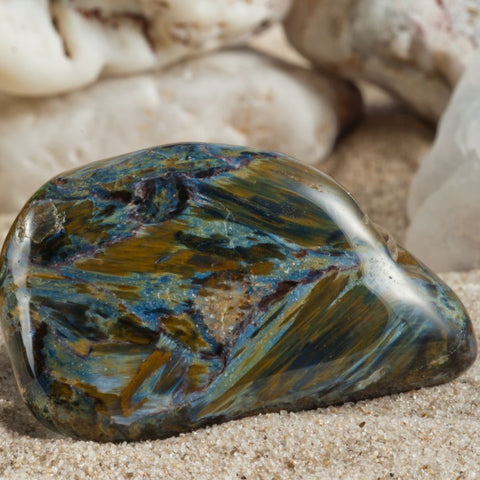
Eagle Eye belongs to the family of microcrystalline quartz, just like the tiger's eye and the falcon's eye. The composition of the Eagle's Eye is silicon dioxide (SiO₂), enriched with iron and crocidolite. Eagle’s eye is also called pietersite, and it’s an aggregate of hawk’s eye and tiger’s eye. As a result, the colouring is more varied than you find with hawk’s eye or tiger’s eye, often including shades of blue, gray, amber, and brown. However, it maintains the blue-hued chatoyancy you would expect from the stone. Eagle Eye stones are known for their chatoyancy (cat's eye effect), which creates a unique optical effect that enhances their beauty in jewelry.
Like hawk’s eye, eagle’s eye is usually opaque or mildly transparent. It also polishes well, resulting in a slight glow, particularly when cut to accentuate the chatoyancy. With a hardness of 6.5 to 7 on the Mohs scale, Eagle Eye stone is perfect for everyday jewelry and can withstand tougher metals and alloys used in jewelry making. Its colour and composition make Eagle Eye jewelry suitable for both men's and women's pieces. Eagle Eye stones pair well with natural textiles, such as leather, and precious metals, such as gold and silver. This beautiful natural stone is highly valued for its unique appearance and durability, making it a preferred choice for jewelry makers. Eagle Eye stone jewelry is often crafted into bracelets, necklaces, and other accessories, emphasizing its aesthetic appeal and symbolic power.
Eagle Eye, Hawk's Eye, and Tiger's Eye are all types of microcrystalline quartz, sharing a similar mineral family but differing in colour, chatoyancy, and metaphysical associations. Understanding these relationships helps collectors and spiritual practitioners choose the right stone for their needs.
Where Are Hawk's Eye and Eagle's Eye Stones Found?
Where Is Hawk's Eye Stone Found?
Primarily, hawk's eye is found in South Africa and Thailand, and those locations serve as the main sources of commercial hawk's eye. However, deposits have also been located in Australia, Bolivia, Brazil, Canada, China, India, Korea, Myanmar, Namibia, Spain, and the United States.
Where Is Eagle's Eye Stone Found?
Currently, there are two primary sources of the eagle's eye stone. It's mined in both Namibia and China.
Hawk's Eye Stone History and Mythology
Hawk's eye was first collected during the early 1800s, with the initial pieces being unearthed in South Africa. Naturalist and explorer Martin Hinrich Lichtenstein examined the stone, described it, and then sent the minerals for further evaluation in Europe.
Since the stone is technically a relatively recent discovery from a scientific perspective, there isn't much mythology associated with it, especially compared to its golden brother, the tiger's eye. However, some cultures associate it with good luck, wealth, energy, and protection.
Now that you know the historical background of Hawk's Eye, let's explore the story behind Eagle Eye stone and how its discovery has shaped its significance today.
Eagle's Eye Stone History and Mythology
Generally, the eagle’s eye stone isn’t known for a long history or distinct mythology, as it wasn’t formally described until very recently. Sid Pieters noticed the stone while prospecting in Namibia's farmland during the early 1960s. He quickly registered his find in Britain, and the stone was formally dubbed pietersite.
Since its discovery was more recent than many other stones, there isn’t a clear connection to cultural significance in the region. However, people have since connected it to various spiritual meanings and metaphysical properties.
Eagle Eye jewelry is often considered a personal talisman, bringing protection and mental clarity to its owner.
With this context in mind, let's delve into the deeper meanings and metaphysical properties that make Eagle Eye stone so valued in lithotherapy and spiritual practices.
Eagle's Eye Stone Meaning and Metaphysical Properties

Eagle Eye stone is highly valued in lithotherapy for its powerful metaphysical properties and unique appearance. It is recognized for its ability to provide grounding, protection, and clarity, making it a sought-after stone for those seeking balance and transformation in their lives. As a talisman, Eagle Eye stone is believed to inspire courage, mental clarity, and positive change, while also supporting emotional balance and spiritual growth.
Below, we break down the key metaphysical properties and benefits of Eagle Eye stone into focused categories for easier reference.
Grounding and Protection
-
Provides strong grounding energy, helping to maintain an earthly connection even during spiritual exploration.
-
Acts as a protective talisman, shielding the wearer from negative energies and external influences.
-
Enhances feelings of safety and stability, making it easier to face challenges with courage.
Chakra Associations
-
Strongly associated with the third eye chakra, promoting intuition, clairvoyance, and spiritual perception.
-
Can also be connected to the sacral and solar plexus chakras, depending on the stone's hue, supporting creativity and personal power.
Emotional and Mental Benefits
-
Calms emotional turmoil and helps restore emotional balance.
-
Cleanses the aura of negative emotions and dispels illusions.
-
Promotes self-confidence and helps remove self-doubt, giving courage to face challenges.
-
Enhances decision-making skills, deep concentration, and clarity of thought.
-
Brings love, happiness, and positive energy into the owner's life by discharging negativity and improving emotional well-being.
-
Believed to improve sight and vision, both physically and metaphorically.
Creativity and Transformation
-
Inspires positive change and stimulates transformation.
-
Promotes creativity by removing blockages and encouraging unconventional solutions.
-
Supports artistic endeavours and helps overcome creative stagnation.
Additionally, Eagle Eye stone is said to be beneficial for asthmatic patients and for digestive system disorders. It can invigorate the nerves and the brain, supporting overall nervous system health.
Having explored the metaphysical significance of Eagle Eye stone, let's now look at the meanings and properties of Hawk's Eye stone for comparison.
Hawk's Eye Stone Meaning and Metaphysical Properties
The meaning of hawk's eye and its associated metaphysical properties vary depending on a person's belief system. However, many consider it a good-luck charm and believe it assists with various spiritual matters and emotional healing. It's also considered an introspective stone that can help someone overcome challenges and develop intuition. Some also connect hawk's eye with astral travel.
Hawk's eye is also associated with a keen ability to identify obstacles before they become problematic. It's similarly associated with the ability to see the big picture, making it easier to navigate complex business situations and build critical alliances.
Now that you understand the metaphysical benefits of both stones, let's discuss how to care for your Hawk's Eye and Eagle's Eye stones to preserve their beauty and energy.
Care and Maintenance of Hawk’s Eye and Eagle’s Eye Stones
Proper care and maintenance are essential to preserve the unique cat’s eye effect and powerful metaphysical properties of Hawk’s Eye and Eagle’s Eye stones. These stones are valued not only for their striking appearance but also for their grounding properties and ability to protect the wearer from negative energies.
Cleaning Tips
To keep your stones looking their best, gently clean them with a soft, damp cloth. Avoid harsh chemicals or ultrasonic cleaners, which can damage the stone’s surface and diminish its natural sheen.
Storage Recommendations
When not in use, store your jewelry in a soft pouch or a separate compartment to prevent scratches and maintain its chatoyant clarity.
Sustainability Considerations
For those who value sustainability, consider eco-friendly jewelry care products and practices. By treating your Hawk’s Eye and Eagle’s Eye stones with respect and mindful care, you not only extend their life but also honour the earth and the artisans who crafted your unique piece.
Because these stones are composed of quartz, they are relatively durable, but it’s still wise to remove them before engaging in activities that could expose them to hard knocks or abrasive surfaces. This helps preserve both their physical properties and their energetic qualities, allowing you to continue benefiting from their relaxing effect and strong will-enhancing power.
This thoughtful approach ensures your jewelry remains a meaningful companion on your journey toward balance, confidence, and inner vision.
With your stones well cared for, let's address some of the most common questions about Hawk's Eye and Eagle's Eye stones.
Common Questions About Hawk's Eye and Eagle's Eye Stones
What Is Hawk's Eye Stone Good For?
Generally, the hawk's eye gemstone is considered a good stone for introspection, helping a person delve into their own mind to find the answers they seek. Additionally, it's said to support intuition, which is closely related to introspection.
However, intuition is often attributed to greater awareness, even if it's primarily subconscious knowledge. As a result, some believe this ability could help a person maintain perspective, identify subtle opportunities, and otherwise find an appropriate path to follow.
Are Hawks Eye and Blue Tigers Eye the Same?
Blue tiger's eye and hawk's eye are the same stone. The name blue tiger's eye is simply an alternative to hawk's eye. Largely, this is simply because more people are familiar with tiger's eye, so referring to hawk's eye as a blue form of tiger's eye makes it easier to envision what the stone looks like, making it a popular alternative.
Is Hawk's Eye Toxic?
Some people worry whether hawk's eye is toxic or dangerous to wear, since the fibres that create the chatoyancy are asbestos and actinolite. While both are potentially hazardous if inhaled, they pose little risk when contained within a stone. As a result, the greatest danger is only present when the gem is cut or polished, not when it's simply worn or held.
What Chakra is Eagle Eye Stone?
Eagle Eye stone is strongly associated with the third eye chakra, also known as the eye chakra. This connection is believed to promote intuition, clairvoyance, and spiritual perception, making Eagle Eye a valuable tool for enhancing awareness of inner thoughts and emotions during meditation and healing practices.
The chakra associated with the eagle eye stone can vary, primarily because it can exhibit a range of hues. However, many people relate it to the sacral and solar plexus chakras. The sacral and solar plexus chakras are commonly connected to tiger’s eye, which could be one of the reasons that eagle’s stones are treated similarly.
But the exact hue could alter the chakra that’s associated with a particular piece of eagle’s eye. As a result, its use can potentially expand to other chakras.
Is Eagle Eye Stone Rare?
Overall, the eagle's eye stone is considered rare. Given the limited number of known sources, it isn't typically mined in large quantities. As a result, it's rarer than tiger's eye and hawk's eye.
However, even as a highly uncommon stone, the eagle's eye gem isn't inherently expensive. While it costs more than tiger's eye and hawk's eye in some cases, any price difference is usually minimal. Partially, that's because eagle's eye crystal isn't necessarily in high demand, which helps keep the price under control.
Is Falcon's Eye Stone the Same as Hawk's Eye?
Falcon's eye is another name used for the hawk's stone, so the two terms do refer to the same gemstone.
If you're interested in exploring alternatives or want to ensure you're purchasing a genuine stone, the next sections will help you identify similar stones and spot fakes.
What Stones are Similar to Eagle Eye Stone and Hawk Eye Stone?
Stones Similar to Eagle's Eye
The stones that are most similar to eagle's eye in composition and core characteristics are hawk's eye and tiger eye. Both have chatoyancy, and the colouring can resemble what you find in an eagle's eye in varying degrees.
However, those aren't the only potential options. A wide variety of gemstones can potentially exhibit chatoyancy. Plus, some are available in blue-gray hues. For example, moonstone can be a bluish-gray. The same is true of aquamarine and crystals. As a result, if your goal is to find an alternative to gray versions of Eagle's Eye, those are strong contenders.
How to Spot Fake Eagle's Eye
Fortunately, fake eagle's-eye gemstones aren't common on the market. Generally, this is because the stone is low-cost enough that creating faux versions isn't financially practical.
Signs of a fake Eagle Eye stone include:
-
Lack of chatoyancy (cat's eye effect) or a band of light that does not move as you shift the stone.
-
Glass or synthetic replicas that do not mimic the natural optical effect.
-
Colors that seem too vibrant or lack natural variation, which may indicate dyeing or other treatments.
However, you may find natural eagle's eye gems that have undergone dying processes or other treatments to enhance their colour. Again, this isn't necessarily common, but if the colours seem too vibrant or lack natural variation, that should give you pause.
Stones Similar to Hawk's Eye
Generally, the stones that are most similar to hawk’s eye are tiger’s eye and eagle’s eye. While the gems' colours vary, the characteristic chatoyancy is present in all three stones.
However, the cat’s eye trait – another term for chatoyancy – describes the optical phenomenon in which a reflective band of light moves beneath the surface of the gemstone, resembling a cat's eye. This effect is also potentially present in other stones. For example, chrysoberyl, apatite, aquamarine, iolite, kyanite, spinel, topaz, tourmaline, and many others can have cat’s eye features. As a result, it’s possible to find blue stones that exhibit chatoyancy that aren’t hawk’s eye.
How to Spot Fake Hawk's Eye
As with eagle-eye, identifying fake hawk's-eye gemstones is tricky. Fortunately, there aren't many faux eagle's or hawk's eye stones on the market, mainly because there aren't many lower-cost stones with the right characteristics.
Signs of a fake Hawk's Eye stone include:
-
A lack of natural colour variations or coloured ribbons is typical of genuine stones.
-
Absence of proper chatoyancy; the band of light does not shift when viewed from different angles.
-
Glass or synthetic stones that do not display the unique optical effect.
-
Stones that have been dyed or treated to enhance colour may appear unnaturally vibrant.
By understanding these key points, you can confidently select, care for, and enjoy the unique beauty and metaphysical benefits of Eagle Eye and Hawk's Eye stones.


