

In the world of gemstones, the mica crystal isn't the most widely known or sought-after. However, it's a strikingly beautiful gem, so it's wise not to overlook its potential in jewelry. Plus, there are far more varieties of mica than most people expect, and each version has a unique look, coloration, or set of features that make the stones highly distinct.
This guide is designed for jewelry enthusiasts, collectors, and anyone interested in the industrial or metaphysical aspects of mica. Understanding mica's unique properties and uses can help you appreciate its value in both practical and spiritual contexts. Mica matters not only for its shimmering beauty but also for its remarkable versatility—spanning from jewelry and collections to essential roles in various industries and spiritual practices.
Ultimately, mica is a fascinating material with uses far beyond jewelry and collections. Here's what you need to know about the mica stone meaning, the metaphysical properties of mica, how mica is used, and much more.
What Is the Mica Group?
Mica is a category of silicate minerals that have similar monoclinic crystal structures but varying compositions, though they’re often recognized by their flaky appearance. Mica minerals are part of the sheet silicates group, known for their distinctive layered structure, which contributes to their flexibility and utility in various industrial applications. The mica group is large, comprising 37 distinct mica minerals, all crystallizing in the monoclinic system with a tendency towards pseudohexagonal habit.
Broadly, the mica stone is known for its shimmery or sparkly look, which makes it attractive for ornamental applications. In fact, the name “mica” is derived from “micare,” the Latin word for “shine.”

Generally, the most common versions of mica are purple lepidolite, black biotite, brown phlogopite, and clear muscovite. Each one has unique features, though they broadly fit in the mica category. For example, lepidolite is lithium-bearing, which sets it apart from most other forms of mica. Mica is classified into two main categories: dioctahedral and trioctahedral micas, based on the structure of their octahedral sheets, which affects their chemical composition and properties.

Biotite and phlogopite are often referred to as common micas, and they are contrasted with trioctahedral micas in terms of their mineral classification. The varying chemical compositions of these minerals influence their properties and their categorization within the mica group.
However, while those mica variants are the most widely used in the world of jewelry, they just scratch the surface of the world of mica.
Mica Physical Properties
When it comes to the physical properties of mica, the various varieties are characterized by distinct layers that create a sense of internal depth. Plus, the layers are easy to split, allowing thin sheets of mica to be turned into thin sheets or flakes for various applications. Muscovite sheets are essential components in industrial applications due to their excellent insulating, thermal, and mechanical properties, making them widely used in products like heating elements, capacitors, and gas discharge lamps.
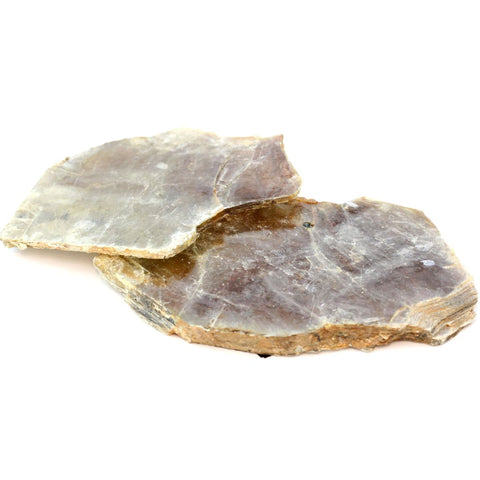
Overall, mica is classified as soft, ranging from a 2 to a 4 on the Mohs hardness scale, depending on the subtype and exact specimen in question. That means it’s often easy to scratch, cut, shape, or manipulate, though the precise degree can vary. Additionally, they can have a pearly to vitreous lustre and range from translucent to opaque. Mica minerals are characterized by their flaky appearance, flexibility, and heat resistance, which make them useful in various industrial applications.
When it comes to colours, the mica crystal properties and varying compositions lead to a rainbow’s worth of hues. Neutrals like grays, browns, and whites occur, as well as striking shades of purple, rose, green, red, yellow, and more. Plus, there are colourless versions. Due to the mica stone's composition, the stones typically have a white or colourless streak.
What’s critical to note is that each type of mica has varying chemical and mineral compositions. As mentioned above, lepidolite contains lithium, and that’s not characteristic of the entire mica group. Phlogopite is known as magnesium mica due to a greater presence of magnesium, while biotite is often iron-rich. Mica is resistant to water penetration and to most acids, alkalis, and solvents, demonstrating its chemical inertness.
However, it’s these varying compositions that can produce a wide array of colours, as specific minerals can alter a stone's hue. For example, lepidolite gets its purple hue from manganese. The high iron content in biotite leads to darker colours, such as black and deep brown.
Crystal Structure of Mica
The remarkable properties of mica stem from its distinctive crystal structure, which sets it apart from many other silicate minerals. At the heart of mica’s structure are its distinct layers, formed by the stacking of tetrahedral and octahedral sheets. The tetrahedral sheets are composed of interconnected silica tetrahedra, while the octahedral sheets contain aluminum or magnesium ions. This layered arrangement creates a highly anisotropic mineral, meaning its properties—such as flexibility, strength, and conductivity—vary with direction.
One of the most notable outcomes of this structure is mica’s ability to split effortlessly into thin sheets. These sheets are not only flexible but also provide excellent thermal insulation, making mica an invaluable material in the electronic and electrical industries. Its crystal structure also renders mica chemically inert, allowing it to withstand exposure to most acids, alkalis, and solvents without degrading. This combination of unique physical properties—flexibility, heat resistance, and chemical stability—explains why mica is so widely used in electrical insulation, heat shields, and other demanding applications. Whether in the form of block mica, sheet mica, or thin flakes, the crystal structure of mica is the foundation of its enduring value in both industrial and decorative uses.
How Is Mica Formed?
Mica is commonly found with igneous and metamorphic rocks, including pegmatite masses, and is especially common in metamorphic rock formations such as schist. Sheet and flake mica can be derived from metamorphic sources like schist, highlighting the significance of metamorphic rock as an alternative to pegmatite deposits and its role in mineral distribution within metamorphic regimes. Though it can occur alongside sedimentary rocks, too, a variety of processes and conditions can lead to mica stones. In some cases, volcanic activity involving magma or fluids can lead to deposits of material that later becomes mica. Placer deposits are also a significant source of flake mica, which is typically mined using open-pit methods.
The weathering of certain minerals – including feldspar – may also play a role in the formation of specific mica gemstones. Processing feldspar is important in the mineral industry for separating it from other minerals such as mica and quartz. Additionally, some versions form on the seafloor due to clastic sedimentation.
When formed, most micas occur as irregular tabular masses, thin flakes, or plates. However, larger mica crystals can happen, and due to their flaky structure, they’re often referred to as books when they occur.

Sometimes, mica forms rosettes, a layered look resembling flower petals. Those commonly become collector’s stones, as other applications usually require cutting or shaping, destroying that particular formation’s natural beauty.
Where Is Mica Found?
Mica is found worldwide, but most of the mica mined comes from India, particularly from Bihar and Madras. Along with being prevalent in those regions, low labour costs make the country ideal for managing the cost of the related operations.

However, there are a few other notable producers of mica. Belgium, Brazil, China, and Madagascar also mine mica regularly, though the mica from those nations is less present in the broader market.
Additionally, many other countries are known to have mica. The trick is that they may not have sources that are large or accessible enough to justify mining, or may maintain only smaller mining operations compared to the nations above. Still, just because a mica gemstone comes from a country other than those listed doesn't mean it isn't authentic.
Mica Types and Forms
Mica is a versatile group of silicate minerals that occurs in several distinct forms, each with its own uses and visual appeal. For collectors and jewelry lovers, exploring broader lists and guides of gemstones can help put mica in context among other minerals. The most recognizable forms are sheet mica, flake mica, and ground mica. Sheet mica, often referred to as mica sheets, consists of thin sheets that can be easily split due to the mineral’s natural layering. Mica sheets are widely used as electrical insulators, thermal conductors, and structural components in heating elements and lighting applications because of their excellent heat resistance and insulating properties. Flake mica, on the other hand, is composed of small, flat pieces and is often used as a filler or extender in the paint industry, where its shimmering quality enhances the paint film and coloured pigments.
Among mica minerals, muscovite stands out for its clear to light-coloured appearance and is highly valued for its insulating properties in the electrical industry. Biotite, typically dark green or brown, is commonly found in igneous and metamorphic rocks and is often used in geological studies and as a raw material in various applications. Phlogopite, with its yellowish-brown or green-white hue, is frequently used as a filler in the paint and rubber industries due to its stability and flexibility. Raw mica crystals can be found in their natural state, while thin sheets of mica are produced by carefully splitting the mineral along its distinct layers. Each form of mica—whether in crystals, sheets, or powder—offers unique benefits, making mica a mineral of choice across multiple industries.
Mica Group Classification and Characteristics
The mica group is a well-defined classification within the family of silicate minerals, renowned for its distinct layers and sheet-like crystal structure. These minerals are chemically inert, meaning they resist reacting with most chemicals, which contributes to their durability and versatility in various applications. The layered structure of mica minerals allows them to be split into thin, flexible sheets, a property that underpins their use in thermal insulation and electrical applications.
With 37 different mica minerals in the group, each exhibits unique physical and chemical properties, but all share the characteristic shimmering appearance that makes mica so captivating. This shimmer is a result of light reflecting off the mineral’s flat, parallel layers. Common mica minerals like muscovite, biotite, and phlogopite are widely used in the electrical, paint, and rubber industries, serving as insulators, fillers, and extenders. The combination of their distinct layers, chemical stability, and visual appeal ensures that mica minerals remain essential in both industrial and decorative contexts.
Mica Uses and Benefits
Mica has a wide variety of uses. While most people focus on mica gemstones in jewelry or in collections, including soothing lepidolite pieces, mica also serves various industrial purposes. Mica offers excellent thermal resistance. Plus, it’s chemically inert, water-resistant, lightweight, and has outstanding dielectric strength.
Some of the main industrial uses of mica include:
-
Insulation products (heat shields, flame-retardant barriers, flight recorder insulators)
-
Electrical and thermal insulation
-
Sheetrock component (improves workability and prevents cracking in drywall joint compounds)
-
Filler in rubber and plastic products (in the rubber industry, mica acts as an inert filler, mould lubricant, and additive in moulded rubber products such as tires, improving mechanical properties and durability)
-
Drilling mud (in the well drilling industry, ground mica is used as an additive in drilling muds to prevent circulation loss and to seal porous sections of drill holes)
-
Paints and pigments (ground mica serves as a pigment extender with colored pigments, brightens the tone, facilitates suspension, reduces chalking, and enhances the resistance of the paint film to water penetration and weathering)
-
Roofing (mica is used to prevent shingles from sticking together)
-
Cosmetics and skincare products (mica is valued for its reflective and refractive properties, making it an important ingredient in products like blushes, eye shadows, and lip gloss)
-
Insulators in high-voltage components and capacitors (muscovite is the industry standard for electrical insulation due to its ability to prevent short circuits)
As a result, mica is often used in insulation products. It’s a component of heat shields for various aerospace vehicles, such as shuttles. You’ll also find it in electrical and thermal insulation, flame-retardant barriers, and flight recorder insulators in spacecraft.
Similarly, mica is found in insulation products in many vehicles, including gasoline-powered and electric models, as well as in home appliances. It’s a sheetrock component and can serve as a filler in certain rubber and plastic products. Ground mica may also be found in drilling mud.

It’s common to find micas in paints and pigments, too. Ground mica is used as a pigment extender with coloured pigments, brightening tones, facilitating suspension, reducing chalking, and enhancing the paint film's resistance to water penetration and weathering. Mica is also used in roofing to prevent shingles from sticking together. Since mica is shimmery and valued for its reflective and refractive properties, it also makes its way into cosmetics and skincare products, serving as an important ingredient in products like blushes, eye shadows, and lip gloss.
When people think of mica crystal benefits, they usually refer to the mica spiritual properties. While the exact uses vary, many view mica as a protective stone. Some also feel that the reflective qualities allow it to deflect negative energy. Many also consider it a calming gemstone, so some use it to restore harmony or balance, much like tranquil blue-green minerals such as aurichalcite.
In this regard, mica is used in several ways. Some choose to wear the stone in a piece of jewelry to carry its potential mica benefits with them. Others prefer to meditate on the gem, using it as a focal point for a spiritual practice or journey. Displaying the crystals can also work as part of a spiritual practice, particularly among those who create altars, just as other visually striking minerals like willemite often do.
At times, mica becomes part of pendulums, too. The related use typically involves some degree of divination or answering challenging questions. In that regard, a protective or balancing stone is a popular addition to a pendulum, particularly when seeking guidance on difficult matters.
Mica Mining and Processing
The journey of mica from the earth to its many applications begins with mining and processing. Most sheet mica is extracted from pegmatite deposits, where large, high-quality crystals can be found. Flake mica, in contrast, is often obtained as a by-product during the processing of feldspar and kaolin resources. Mining methods typically include open-pit and underground techniques, depending on the deposit's location and quality.
Once extracted, the mica-bearing rock is crushed and ground to release the mica mineral. The separation process involves several steps, such as flotation, magnetic separation, and meticulous hand sorting, to ensure purity and quality. Ground mica is produced by grinding the mineral into a fine powder, which is then used as an inert filler and extender in industries like paint, rubber, and plastics. This careful processing preserves the unique properties of mica, allowing it to enhance products ranging from moulded rubber goods to high-performance coatings.
Mica in History

Mica has long been a useful stone, with uses dating back to ancient times. Egyptians, Greeks, Indians, and Romans were known to use mica, as were the ancient Chinese, the Aztecs, and many others.
There's even evidence of mica in cave paintings from the Upper Paleolithic period. The earliest hues discovered were red and black, and there are examples of white drawings, including those made with mica.
In the Southwestern United States, mica was used in indigenous pottery, and the Picuris Pueblo and Taos continue to use it for that purpose today. Mayans added it to clay and stucco to make templates shine in the sun.
In Pakistan, mica added a glittery quality to women's clothing, particularly during the summer. There, along with in Bangladesh and India, mica powder also decorated pottery to make it sparkle.
Mica powder is also present in Japanese woodblock prints, primarily to make the image glitter. There are also examples of its use in pottery.
There are also ancient medicinal practices that involve mica. One example comes from Ayurveda, where mica was said to help treat respiratory or digestive diseases or issues.
Cultural Significance of Mica
Throughout history, mica has captivated cultures around the world with its shimmering appearance and unique physical properties. Its ability to be split into thin sheets made it a prized material for decorative arts, jewelry, and ceremonial objects in ancient civilizations. Mica powder and ground mica were often used to add a sparkling effect to pottery, textiles, and paintings, enhancing the appearance of these materials and imbuing objects with a sense of luxury and mystique.
Beyond its visual appeal, mica has long been associated with metaphysical properties and healing traditions. In many cultures, raw mica was believed to deflect negative energy and promote self-reflection, making it a popular choice for crystal healing and meditation practices. The mineral’s perceived healing properties extended to traditional medicine, where it was used to support skin health and reduce stress.
Today, mica continues to hold cultural significance in both spiritual and artistic communities. Its use in moulded rubber products, electronic equipment, and artisan jewelry reflects a blend of ancient tradition and modern innovation. Whether as a symbol of clarity and protection or as a captivating mineral in contemporary design, mica’s enduring allure lies in its ability to bridge the worlds of art, industry, and spirituality.
Mica Metaphysical Properties
The metaphysical properties of mica can vary dramatically depending on a person's belief system and the exact type of mica involved. Some feel mica's spiritual meaning focuses on reducing or eliminating nervous energy or hostile energy. It's generally considered a protective stone, too.
However, the mica rock meaning can change if you're looking at a specific type of mica. For example, the lepidolite mica crystal meaning focuses on calmness, clarity, and harmony, and, since it's purple, it is associated with the crown chakra.

The green mica crystal meaning – which usually involves the meaning of fuchsite since it's green – aligns with the heart chakra instead and is often associated with compassion, love, and rebirth.
When it comes to mica crystal healing properties, those can also vary depending on the type of mica. However, many broadly believe that it can bring balance to the body and chakras, levelling out a person's energetic system. The mica stone healing properties are also associated with anxiety and emotional stress reduction, leading to increased emotional stability.
Some also feel that mica can assist with a variety of ailments. For example, some think it can relieve insomnia and decrease muscle pain. Others believe it can address skin inflammation or rashes and promote healthy cell regeneration.
Many even feel it can help in the battle against an eating disorder, leading to a better relationship with food. One of the green mica healing properties potentially counters that, as some think the stone can reduce hunger during fasting or cleansing, which potentially isn't conducive to dealing with specific eating disorders.
However, it's critical to note that any healing benefits of mica – including the ability to prevent or treat any condition – aren't scientifically proven. As a result, holding, wearing, or meditating on mica isn't a substitute for legitimate medical care. Instead, getting guidance from a healthcare professional if you're experiencing any health concerns is essential.
Crystal Healing with Mica
In the realm of crystal healing, mica is cherished for its gentle yet powerful metaphysical properties. Mica powder and raw mica are often used in meditation and energy work to foster a sense of calm and balance. The mineral is believed to help dissipate negative energy, making it a popular choice for those seeking emotional clarity and protection. Many practitioners turn to mica for its reputed ability to encourage self-reflection and introspection, supporting personal growth and heightened intuition.
Beyond its calming influence, mica is said to possess healing properties that may reduce inflammation and promote healthier skin. In crystal healing practices, mica is used to balance the body’s energy, harmonize the chakras, and create a peaceful environment for spiritual work. Whether incorporated into jewelry, placed on an altar, or used as mica powder during meditation, this mineral continues to inspire those drawn to its soothing and transformative energy.
Mica in Jewelry

While mica has many industrial uses, the mica gemstone is highly popular for jewelry. However, because its appearance can vary significantly from one specimen to the next, jewelry featuring it usually doesn't end up in chain stores. With chains, consistency is critical. Additionally, the ability to repeat a design at scale is often a must, which is why more unusual stones like iolite gemstone also tend to appear in pieces by independent designers.
Fortunately, independent jewelry designers can take advantage of beautiful mica gemstones. They have an easier time supporting small runs or one-off pieces, allowing them to celebrate the amazing look of mica without the drawbacks that chains face.
Generally, mica isn't faceted for jewelry, as its structure and lack of full transparency make it ill-suited to faceting. Instead, mica is more often shaped and polished, used to create cabochons, or turned into beads. Some pieces may even feature raw mica.
It's also common to find mica in pendulums designed for various spiritual or divination practices. Often, these include beads or polished stones, though some may feature cabochons or raw mica crystals as well.
Stones Similar to Mica
Generally, not many stones are similar to mica. One reason is that the shimmering quality characteristic of many types of mica found in other gems is actually the result of mica. For example, aventurine – a kind of green quartz – has a shimmer known as aventurescence, which results from mica inclusions.
Mica can also occur as inclusions in other types of quartz, imbuing them with a shimmery quality. The same can occur with fluorite crystals and many other gemstones. Sparkly granites can contain mica, too.
Goldstone is known for its glittering quality, as well. It's a manufactured stone that includes coloured glass with metallic inclusions, usually copper, chromium, or manganese filings, flakes, or granules.
In some cases, stones known for a metallic lustre may also resemble specific micas. For example, pyrite –commonly referred to as fool's gold – is a mineral known for its metallic appearance. Some gems also display dramatic colour shifts due to pleochroism in gemstones, which can enhance or contrast with mica’s own shimmer. Chalcopyrite can also have a metallic quality, leading to a shimmer.
Conclusion
Mica stands out as a captivating mineral, celebrated for its unique physical properties and wide-ranging applications. From its essential role in the electronic and electrical industries to its valued place in crystal healing and metaphysical practices, mica’s shimmering appearance and versatility make it both beautiful and functional. Its chemical inertness, sheet-like structure, and ability to serve as a filler and extender in the paint and rubber industries further highlight its importance.
Whether you’re drawn to mica for its industrial uses, its metaphysical properties, or its role in artisan jewelry, this mineral offers something for everyone. As research and innovation continue to reveal new possibilities, mica’s enduring appeal ensures it will remain a vital and inspiring part of our world for years to come.


