

Explore the world of Rhyolite, a unique stone favoured among those who love standout jewelry and collectibles. Rhyolite is a silica-rich volcanic rock, notable for its geological significance and unique mineral composition. Its distinct look makes it special, but it’s not well known, so many overlook it. If you want to learn more about Rhyolite, here’s what you need to know.
Rhyolite Properties: What is Rhyolite Stone?
While some people assume Rhyolite is a crystal or gemstone, the answer is that rhyolite is considered a rock. More specifically, it’s a felsic igneous rock, which forms from the cooling and solidification of magma or lava. Many rhyolites form from granitic magma that has partially cooled in the subsurface before erupting. Explosive or effusive volcanic eruptions can produce rhyolite, especially when granitic or silica-rich magmas are involved. Rhyolite forms from felsic magma, particularly in volcanic areas near continental plate boundaries. It’s part of the same general family as granite and basalt, but with some distinct differences.
Regarding the composition, the rhyolite rock has a very high silica content. Rhyolite’s chemical composition, particularly its high silica content, makes the magma more viscous, which influences its physical properties and eruption style. That’s why many call it the rhyolite crystal, as the silica can give the stone a sparkly quality. Rhyolite is made up primarily of quartz, plagioclase, and sanidine, with minor amounts of hornblende and biotite. Pyroxene can also be present as a minor mineral in some rhyolite specimens.
Within rhyolite, there’s usually a mix of other stones and minerals. In most cases, there’s quite a bit of plagioclase - a group of feldspar minerals – and sanidine. Rhyolite is composed of several rock-forming minerals, including quartz, feldspar, and biotite. In some cases, you may also find biotite and hornblende.
COMPOSITION AND FORMATION OF RHYOLITE
-
Silica Content: Rhyolite is a high-silica rock containing more than 69% silica (SiO2). This high silica content is key to its physical characteristics and appearance.
-
Formation: Rhyolite lavas erupt as thick domes constructed directly over the volcanic vent. Slow, viscous rhyolitic lava can pile up around the vent, forming mound-shaped domes. It forms from the rapid cooling of high-viscosity lava. Because the lava cools quickly, crystals don’t have much time to develop, resulting in the fine-grained texture of Rhyolite. In some cases, the cooling is so rapid that the material forms a natural glass known as obsidian.
-
Texture and Structure: Rhyolite typically has a fine-grained texture but can also contain larger, clearly visible crystals embedded within a finer matrix. This is known as a porphyritic texture, where the larger crystals are referred to as phenocryst minerals. The cooling process plays a crucial role in determining the texture: rapid cooling produces fine-grained or glassy textures, while slower cooling allows larger crystals to form within the rock.
Rhyolite is frequently associated with volcanoes that produce thick lava flows and lava domes, and explosive rhyolite eruptions can produce tuff deposits. The Andrew Strait Volcano is a notable example, known for its rare eruptions of granitic magma and highly explosive rhyolite eruptions, which highlight its significance in silicic volcanic activity and the formation of volcanic landforms, such as lava domes.
The presence of Rhyolite is often an indicator of specific geological processes, such as the melting of the Earth’s crust or the activity of continental hotspots. Rhyolite is important in studying volcanic processes, especially explosive volcanism, due to its high viscosity, as it’s often associated with highly explosive eruptions that eject material violently, rather than flowing as lava.
Rhyolite Colour & Varieties
Since rhyolite can contain a mix of gems and minerals, each stone is unique. The variable composition means you can find rhyolite in several colours and patterns, which many appreciate. Rhyolite specimens can vary widely in appearance due to differences in mineral content and formation conditions.
Most rhyolite is pink or gray, although some samples may lean toward lavender due to the mix of pink and gray hues. Rhyolite is usually pink or gray in colour with grains so small that they are difficult to observe without a hand lens. With raw rhyolite, the shades tend to be gentle pastels. However, once polished, it can become stronger.
Another popular variant is green rhyolite. Typically, green shades tend to be fairly earthy, featuring hues such as pistachio, olive, moss, and forest.

There are several varieties of Rhyolite, each with unique characteristics and sometimes distinct names. These varieties are often distinguished by their appearance, the presence of specific minerals, or the conditions under which they are formed. Here are some notable rock types below, along with examples of rhyolite varieties such as banded rhyolite and leopard skin rhyolite:
-
Pumice: This is a very porous and lightweight form of Rhyolite. It forms when highly gas-charged lava is ejected during a volcanic eruption. The rapid cooling and depressurization create a frothy, bubble-rich rock that can float on water.
-
Obsidian: While technically a natural glass rather than a crystalline rock, Obsidian is often associated with Rhyolite. It forms from the rapid cooling of Rhyolite lava, resulting in a smooth, glassy texture. Obsidian is usually black but can have various colours depending on impurities.
-
Tuff: This type of rock is formed from volcanic ash ejected during explosive eruptions. When this ash settles and compacts over time, it forms Tuff, often associated with Rhyolite compositions.
-
Banded Rhyolite: Characterized by its striking layered or banded appearance, this variety results from the flow of the lava as it cools, creating bands of different colours and textures. Specimens of banded rhyolite often display dramatic stripes or swirls.
-
Liparite is another name sometimes used for Rhyolite, particularly in European contexts. It’s named after the Lipari Islands near Sicily, where the rock is common.
-
Comendite and Pantellerite: These are high-silica varieties of Rhyolite, often found in oceanic settings. They are named after specific locations where they were first identified.
-
Rhyolite Porphyry: This variety features larger, well-formed crystals (phenocrysts) set within a fine-grained matrix. The phenocrysts are often quartz, feldspar, or biotite.
-
Flow-Banded Rhyolite: This type exhibits evidence of lava flow in its banding, characterized by alternating layers that vary in colour, grain size, or mineral composition.
-
Rainforest rhyolite is a version of green rhyolite. With rainforest rhyolite, there are several colours within a stone. Along with a selection of earthy greens, you may find creams, beiges, and browns, as well as the occasional spot of muddy yellow or orange.
-
Leopard skin rhyolite features warmer colours like yellows, oranges, reds, creams, browns, and near-blacks. Additionally, it tends to have a spotted appearance, which is how it earned its nickname, the leopard skin. Specimens of leopard skin rhyolite are popular examples due to their distinctive patterns.
There are instances where you can find nearly any colour within a rhyolite rock. After all, it is common for the vugs to contain other gems. Topaz, agate, jasper, beryl, obsidian, and opal are just some of the gemstones that could make an appearance. Fire Opal is sometimes found filling cavities in rhyolite.
The History of Rhyolite
The name “Rhyolite” originates from the Greek words “rhyx” (ρύξ) and “lithos” (λίθος), which mean “flow” and “stone,” respectively. This name was chosen to reflect the rock’s volcanic origin and characteristic flow structures, often visible in the rock’s texture and patterns.
Rhyolite forms from the rapid cooling of high-silica lava, which flows more slowly and viscously than basaltic lava. The term was introduced into geology in the mid-19th century by the German geologist Ferdinand von Richthofen, who was also famously known as the 'Red Baron.' This nickname, most closely associated with the World War I fighter pilot, is connected to the naming history of rhyolite and highlights Richthofen's influence as an early figure in the study of volcanic rocks.
Prehistoric Use
Early Tools and Weapons: In prehistoric times, Rhyolite was often used to make tools and weapons. Its ability to break into sharp edges made it suitable for crafting scrapers, hoes, axe heads, spear points, arrowheads, and other primitive tools. Stone tools made from rhyolite were common in areas where different materials were scarce. This was particularly true for varieties like Obsidian, a natural volcanic glass often associated with Rhyolite.
Significance in Early Societies: In some ancient cultures, Rhyolite and its varieties, especially Obsidian, were highly valued not just for their practical uses but also for their aesthetic and possibly symbolic significance.
Ancient Civilizations
Construction Material: In ancient civilizations, Rhyolite was sometimes used as a construction material. Its durability and availability in certain regions made it a practical choice for building. Rhyolite was often chosen for building structures that required withstanding the elements and enduring over time.
Art and Decoration: The unique patterns and colours of Rhyolite may have also been appreciated by ancient artisans. Evidence suggests that it was used in decorative art and possibly jewelry, although this was less common than other stones, such as jade, rutile, or turquoise.
Cultural Significance
Mythology and Folklore: Like many natural stones, Rhyolite likely held a place in the mythology and folklore of various cultures, although specific stories or beliefs may be less documented compared to more widespread stones like quartz or diamonds.
In some spiritual traditions, rhyolite is believed to help individuals build inner strength, confidence, and a deeper connection to their emotions or spiritual energies.
Trade and Exchange: In regions where Rhyolite was particularly abundant or had unique qualities, it may have been a part of trade networks, especially in the form of tools or raw materials.
Modern Context
Geological Study: In modern times, Rhyolite has become an important subject of study in geology and volcanology. Its formation provides insights into the Earth's volcanic processes and the history of volcanic regions.
Contemporary Use: Today, Rhyolite is primarily valued for its aesthetic qualities in jewelry and ornamentation. Polished rhyolite is often cut into cabochons for jewelry. Its diverse appearance makes it popular among collectors and jewelry designers.
Where is Rhyolite Found?

Generally speaking, rhyolite is usually found in areas with continental volcanic eruptions. It is often present in regions with other volcanic features such as geysers and river-like lava flows, highlighting the dynamic geological activity in these areas. While it may also form from oceanic eruptions, that is far rarer. Additionally, it’s created in regions where granitic magma eruptions occur, which somewhat limits its distribution. The high gas content and high viscosity of rhyolitic magmas are conducive to explosive eruptions. Rhyolite is commonly found at convergent plate boundaries, where oceanic plates subduct beneath continental crust. Rhyolite is frequently associated with volcanoes that produce thick lava flows and lava domes, and explosive rhyolite eruptions can produce tuff deposits.
One of the most famous examples of a rhyolite-related site is the historic ghost town of Rhyolite, Nevada. Located near Death Valley, Rhyolite was built during the early 20th-century gold rush as part of the Bullfrog District. The town experienced a rapid rise and decline, fueled by the discovery of the Montgomery Shoshone Mine, which played a central role in its growth. At its peak, the town boasted many notable buildings, including a train depot, an opera house, and the famous Bottle House, constructed from thousands of beer and liquor bottles. These buildings remain as relics of the town's vibrant past, attracting visitors interested in Nevada's mining history. Figures such as Old Man Beatty, who lived nearby, add to the colourful history of Rhyolite and the Bullfrog District.
North America:
United States: One of the most famous locations for Rhyolite is Yellowstone National Park, where large rhyolite lava flows and other volcanic formations are a key feature of the park’s geology. The Long Valley caldera in California is a notable site where significant rhyolite eruptions have occurred. Nevada, Utah, and New Mexico also have significant Rhyolite deposits. Mount St. Helens is well known for its history of lava dome formation and explosive eruptions. According to the United States Geological Survey, eruption data from these regions highlight the frequency and impact of rhyolite eruptions.
Alaska: Alaska is notable for the 1912 Novarupta volcano eruption, which was a significant rhyolite event and one of the largest eruptions in the 20th century.
Mexico: Certain regions, particularly those with a history of volcanic activity, have notable Rhyolite formations.
Canada: Although not common, Rhyolite is found in areas with a history of previous volcanic activity, including British Columbia, Yukon Territory, and the Appalachian region of New Brunswick.
Europe:
Iceland: Known for its active volcanism, Iceland has Rhyolite in several areas, often characterized by stunning colours and patterns.
Italy: The Lipari Islands, particularly the island of Lipari, have historical Rhyolite quarries. The term ‘Liparite’ is sometimes used in European contexts to refer to Rhyolite.
Germany: The Black Forest region has Rhyolite deposits.

Oceania:
New Zealand: The North Island of New Zealand, with its volcanic history, contains Rhyolite, especially in areas like Taupo and Rotorua. Rhyolite eruptions have also occurred in Papua New Guinea, marking it as a significant location in volcanic history.
Australia: Regions with ancient volcanic activity, such as southeastern Australia, contain Rhyolite formations.
South America:
Chile and Argentina: The Andes mountain range, known for its volcanic activity, has Rhyolite formations.
Asia:
Japan: Certain volcanic regions in Japan have Rhyolite deposits.
Rhyolite Jewelry
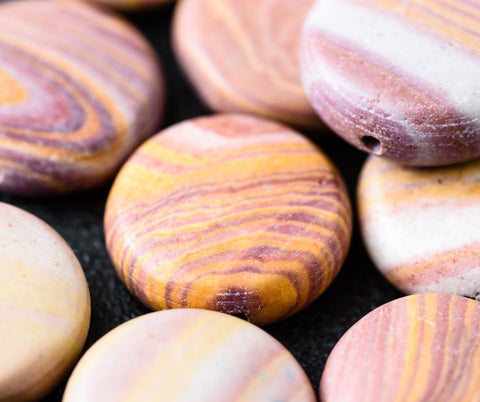
Rhyolite isn't commonly found in pieces at chain jewelry stores. Typically, the stone lacks sufficient consistency, rendering it unsuitable for mass production. However, many independent jewellers enjoy creating rhyolite jewelry.
Since rhyolite is mainly opaque, rhyolite jewelry usually features polished stones. Cabochons are a popular option, though tumbled rhyolite stones are also a favourite, particularly among designers who prefer a more organic look. Rhyolite beads are also widely available, often appearing in strand necklaces and bracelets.
Rhyolite Meaning: What Does Rhyolite Symbolize?

The meaning of the rhyolite gemstone can vary depending on a person's belief system. Here are a few of the common rhyolite crystal properties:
Change and Progress: Rhyolite is often associated with change, transformation, and progress. It's believed to help individuals embrace change and move forward, especially during times of challenge or uncertainty.
Creativity and Self-Expression: This stone is thought to enhance creativity and self-expression. It's said to help unlock the creative potential and encourage the expression of one's true self.
Connection with Nature: Given its volcanic origin, Rhyolite is often regarded as a stone that fosters a deeper connection with nature and the Earth. It's believed to encourage a sense of environmental responsibility and appreciation for the natural world.
Self-Realization and Personal Growth: Rhyolite is believed to support self-realization and personal growth. It's supposed to help individuals understand their true nature and purpose, encouraging them to reach their full potential.
Rhyolite Metaphysical Properties and Benefits

Past-Life Healing: Rhyolite is utilized in some spiritual practices for past-life healing. It's thought to help access and heal past life experiences that might impact the present.
Meditation and spiritual exploration: Rhyolite is also used in meditation, where it's believed to aid in spiritual exploration and gaining insight into complex situations.
Rhyolite Healing Properties

Physical Healing: While not its primary association, some believe Rhyolite can aid in physical healing, particularly in strengthening the immune system and detoxifying the body.
However, it's essential to note that there is no scientific evidence to suggest that holding, wearing, or meditating on rhyolite has any health-related benefits. Additionally, gems shouldn't be used as a substitute for professional medical care. Still, there's usually little harm in possessing rhyolite.
Stones Similar to Rhyolite

Finding substitutes is challenging since rhyolite rocks feature a mix of minerals and stones. In some cases, pieces of agate may resemble rhyolite. However, agates tend to have stripes or striations, while rhyolite usually doesn't.
Certain types of jasper may resemble rhyolite. Like rhyolite, jasper comes in various colours and patterns, so you may find pieces that resemble one another. The same can be true of some kinds of granite.
Frequently Asked Questions About Rhyolite
What is special about rhyolite?

Rhyolite is special for its unique appearance, often featuring striking patterns and vibrant colours. As a volcanic rock, it embodies the dynamic processes of Earth's interior, and its fine-grained texture is a testament to the rapid cooling of lava.
Is rhyolite valuable?
Rhyolite's value is more aesthetic than monetary. It's not as rare or precious as some gemstones, but its unique patterns and colours make it sought after for decorative purposes, especially in jewelry and ornamental objects.
What is rhyolite used for?
Rhyolite is primarily used for decorative purposes, including jewelry, ornamental stones, and occasionally in construction. Its unique appearance makes it popular among collectors and artisans.
What is rhyolite made of?
Rhyolite is composed predominantly of silica (SiO2) and a mixture of other minerals, including quartz, feldspar, and mica, which gives it a high silica content similar to that of granite.
How can you tell if a rock is rhyolite?
Rhyolite can be identified by its fine-grained texture, often light colour, and frequently banded or layered appearance. It's also relatively lightweight and sometimes has a glassy or pumice-like surface.
What chakra is rhyolite?
In crystal healing, Rhyolite is often associated with the Heart Chakra, believed to aid in emotional balance, self-love, and personal growth. It's thought to enhance self-esteem and self-worth.
Is Rhyolite a Jasper?
No, Rhyolite is not Jasper. While both are siliceous stones and can have similar appearances, Jasper is a form of chalcedony, a microcrystalline form of quartz. In contrast, Rhyolite is a volcanic rock with a different composition and formation process.
Is rhyolite intrusive or extrusive?
Rhyolite is an extrusive igneous rock. It forms from lava that cools rapidly at or near the Earth's surface, unlike intrusive rocks that cool slowly beneath the surface.
What is the difference between granite and rhyolite?
The main difference is in their formation. Granite is an intrusive igneous rock that forms slowly beneath the Earth's surface, allowing large crystals to develop. Rhyolite, being an extrusive rock, cools quickly at the surface, resulting in a fine-grained texture. Both have high silica content.


