

Introduction
Clinohumite is one of the rarest gemstones worldwide, a striking orange-yellow collector stone often mis-sold as "Fire Spinel." In this article, we explore its geology, its physical and optical properties, and how it compares to true spinel, so you can make informed decisions whether you are collecting or considering it for jewellery. This guide is for gem collectors, jewelry enthusiasts, and anyone interested in rare minerals. Understanding clinohumite helps collectors and buyers avoid confusion with spinel and appreciate its unique properties.
Key Takeaways
-
Clinohumite is a rare, hydrated magnesium iron silicate from the humite group, first discovered in 1876 at Mount Vesuvius in Italy-it is not a spinel despite the misleading trade name "Fire Spinel."
-
Gem-quality clinohumite comes mainly from Tajikistan's Pamir Mountains (discovered in the 1980s), Russia's Taymyr region (discovered around 2000), and Tanzania's Mahenge Plateau, appearing in vivid yellow-orange to brownish-orange hues.
-
Core properties include a refractive index of about 1.630–1.665, specific gravity around 3.22–3.23, positive biaxial optical character, and a hardness of 6 on the Mohs scale, making it softer than spinel or sapphire.
-
Collectors prize clinohumite for its extreme rarity, distinctive colour, mantle-related origin, and limited deposits that may be nearing depletion.
-
Clinohumite is valued mainly by mineral collectors and for its gem-quality specimens in limited quantities; transparent, well-cut crystals are highly sought after.

What Is Clinohumite?
Clinohumite is a rare magnesium silicate mineral belonging to the humite group. Clinohumite is a rare magnesium silicate mineral belonging to the humite group-a family whose members also include humite, chondrodite, and norbergite. Unlike more familiar gemstones such as peridot or spinel, clinohumite is a hydrated magnesium iron silicate with the chemical formula (Mg,Fe)₉(SiO₄)₄(F,OH)₂, where Mg, fluorine, and hydroxyl components reflect its "hydrated" nature.
The name itself tells a story: "clino-" references its monoclinic crystal system, while "humite" connects it to the mineral humite first described at Mount Vesuvius. Early 19th-century European mineralogy records its discovery in 1876 in metamorphosed limestone ejecta at Mount Somma, part of the Vesuvius volcanic complex in Italy. Gemmologists classify it as a contact-metamorphic mineral that also occurs as a minor component in peridotite from the Earth's mantle.
While clinohumite itself is extremely rare in commercial jewellery, at Fierce Lynx Designs we believe understanding niche gems helps our clients appreciate the full spectrum of nature's artistry-and informs custom work with similarly characterful stones.
Formation, Geological Occurrence, and Notable Deposits
Clinohumite forms in two primary environments: contact zones where hot igneous rocks react with limestone or dolomite, and deep mantle peridotites that carry the mineral upward through tectonic uplift. It typically forms in high-temperature magnesium-rich metamorphic environments and often appears as individual grains within metamorphosed carbonate host rocks. Clinohumite is formed under high pressure and high temperature and can store water in the Earth's mantle-a fact that has drawn attention from researchers published in the journal American Mineralogist.
At the type site near Mount Vesuvius, clinohumite can occur in volcanic ejecta near carbonate rocks, where white limestone blocks metamorphosed by magmatic heat produced small grains of the mineral. Clinohumite is often found in contact metamorphic zones adjacent to plutonic rocks and can occur alongside minerals like spinel and calcite, as well as forsterite, grossular garnet, and wollastonite.
The global distribution of clinohumite is broad-it has been reported from Antarctica, Brazil, Canada (Ontario and Quebec), European localities including Italy, Norway, and Austria, and US states such as New York and New Jersey. However, most of these occurrences yield only opaque, non-gem sample material.
The Pamir Mountains in eastern Tajikistan remain the most celebrated gem source. Gem-quality clinohumite was found in the Pamir Mountains in the 1980s, revealing vivid yellow to orange crystals in marble that quickly became sought by collectors. Another gem-quality deposit was discovered in the Taymyr region of northern Siberia around 2000, producing darker brown and brownish-yellow to yellow-brown stones, occasionally fashioned into attractive small gems. More recently, the Mahenge Plateau in Tanzania has emerged as a source of bright orange clinohumite, commonly found alongside famous Mahenge spinels.
All known deposits are geologically small, and clinohumite is mined sporadically because of its rarity. There is growing concern that the Pamir and Taymyr sources may be largely depleted within the coming decades.

Physical and Optical Properties of Clinohumite
This reference-style section is for gem and jewellery enthusiasts seeking identification details. The table below summarises clinohumite's key characteristics:
|
Property |
Clinohumite |
Comparison: Spinel |
|---|---|---|
|
Crystal system |
Monoclinic (space group P21/b) |
Cubic |
|
Hardness (Mohs) |
6 |
8 |
|
Specific gravity/density |
3.22–3.23 g/cm³ |
3.58–3.61 |
|
Refractive index |
1.630–1.665 |
~1.718 |
|
Optical character |
Biaxial positive, birefringent |
Singly refractive |
|
Lustre |
Vitreous to slightly resinous |
Vitreous |
|
Transparency |
Transparent to translucent |
Transparent |
|
Cleavage |
Poor |
None (conchoidal fracture) |
|
Tenacity |
Brittle |
Brittle |
Pleochroism is moderate to strong—view a sample from different directions, and you may see shifting yellow, orange, or pale tones, a textbook example of pleochroic colour variations in gemstones. Under magnification, diagnostic inclusions such as minute spinel crystals, rutile needles, fluid inclusions, internal fingerprints, and growth lines help gemmologists identify the stone. Some specimens show orange-yellow fluorescence under shortwave UV light.
Clinohumite's crystal structure comprises isolated SiO₄ tetrahedra and Mg-octahedral layers related to the olivine structure. Its colour ranges from yellow, golden, and orange to brownish orange, reddish brown, and dark brown hues depending on iron and titanium content. Non-gemmy crystals can appear translucent or opaque with silky zones.
Clinohumite cleavage is poor, and the stone is brittle, which, combined with its moderate hardness, means it requires careful handling and specialised gemstone jewellery cleaning methods. These physical and optical properties collectively distinguish it from singly refractive spinel in any gemology lab.
Clinohumite vs. Spinel: The Truth Behind "Fire Spinel"
In markets like Bangkok, clinohumite is sometimes labelled "Fire Spinel" to capitalize on spinel's prestige. This comparison is misleading. Clinohumite is a hydrated magnesium iron silicate in the humite group, while spinel is magnesium aluminum oxide (MgAl₂O₄)-an entirely different mineral group. This chemical difference underpins every divergence in their properties.
Clinohumite is monoclinic, forming irregular or prismatic crystals, while spinel is cubic and commonly displays octahedral habits. Optically, clinohumite is biaxial and birefringent with double refraction visible under magnification; spinel is singly refractive and shows no pleochroism. Even in photo comparison, clinohumite typically shows less "sharp" brilliance than high-quality spinel. Spinel often contains octahedral magnetite inclusions, whereas clinohumite reveals metamorphic-origin phases.
Fine clinohumite can reach prices from roughly USD $220 up to around $2,000 per carat for top orange stones from Pamir or Mahenge-a niche collector pricing that contrasts with spinel's broader market. Buyers are reminded to seek gemmological documentation when purchasing "Fire Spinel," as an independent lab report clarifying whether the stone is spinel, clinohumite, or another material is essential. At Fierce Lynx Designs, clear and ethical gemstone labelling is always our standard, rooted in a broader commitment to transparency in ethically sourced gems.
Clinohumite in Jewellery and Collector Stones
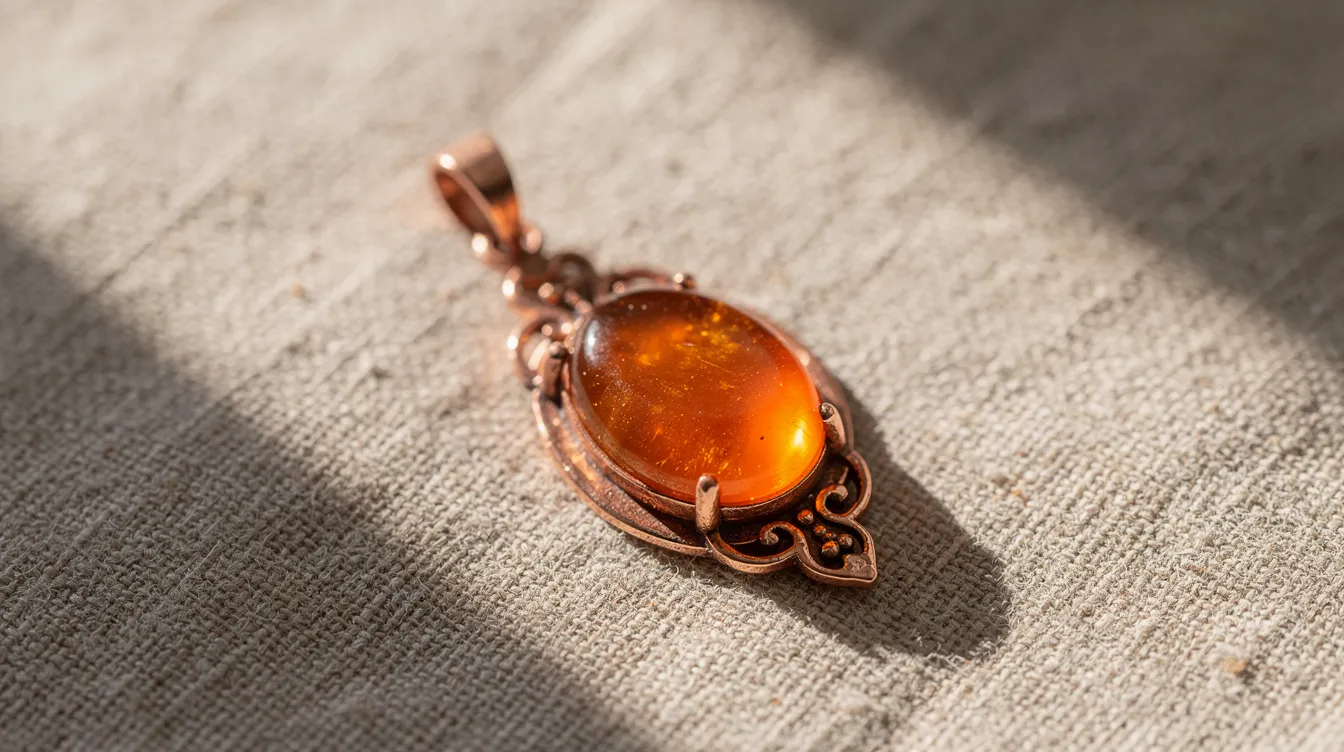
Clinohumite remains primarily a collector's gem, though it does appear in bespoke artisan jewellery. Most faceted stones fall between 0.3 and 3.0 carats; gems above 3 carats are scarce. Many collectors also value uncut crystals and matrix specimens. Cutters favour oval, cushion, and emerald cut shapes to maximize colour. Bright golden and orange hues from Pamir and Mahenge are especially sought for pendants and statement rings.
With a Mohs hardness of 6, clinohumite is more vulnerable to scratching than everyday-wear stones. Bezel settings or protective mountings are recommended for rings; earrings and pendants are safer for long-term wear. Clean with mild soap, lukewarm water, and a soft brush-avoid ultrasonic cleaners. Store it separately from harder stones.
Due to scarce supply, clinohumite would most likely appear in our special commissions or limited pieces, combined with complementary gems such as garnet, spinel, or citrine. Not all clinohumite on the market meets our traceability standards, which can limit its use-but ensures integrity when we do offer it.
Metaphysical, Symbolic, and Design Inspirations
Clinohumite lacks the long healing tradition of quartz or garnet, but modern crystal enthusiasts assign it meanings rooted in its colour and extraordinary origin, much like the stones explored in our broader gemstone lists and guides hub. It is often linked with vitality, creativity, and courage-a stone of transformation and resilience forged under extreme heat and pressure.
Practitioners associate clinohumite with the sacral and solar plexus chakras, reinforcing themes of confidence, personal power, and joyful expression. Pairing it with grounding stones like smoky quartz or black tourmaline creates balance. Design themes of volcanic fire, deep Earth, and metamorphosis pair beautifully with warm metals-rose gold-filled components, brass accents, or copper-popular in Canadian handmade jewellery.
As a symbol of uniqueness, clinohumite is ideal for milestone gifts or pieces commemorating life-changing experiences. At Fierce Lynx Designs, we create limited-run gemstone earrings and bracelets where a stone like this fits naturally. References in gemological literature, including entries in any colour encyclopedia or a gemstone guide's sixth edition, confirm its introduction as a collector favourite in recent decades.
Please note: metaphysical and crystal healing interpretations are spiritual or symbolic in nature and are not a substitute for medical or professional care.
FAQ
Below are extra questions about clinohumite focusing on practical buying and collecting concerns.
Is clinohumite suitable for an everyday engagement ring?
With a Mohs hardness of about 6 and brittle tenacity, clinohumite is a risky choice for daily wear. It scratches more easily than sapphire, diamond, or spinel. If you insist, choose a protective bezel or halo setting and inspect it regularly-or reserve it for occasional-wear jewellery.
How can I tell if a "Fire Spinel" is really clinohumite?
Visual inspection alone is unreliable. A qualified gemmologist can distinguish the two through refractive index measurements, polariscope tests (single vs. double refractive behaviour), and specific gravity checks. Always ask for an independent lab report when purchasing higher-value stones.
Does clinohumite have any official status as a birthstone?
Clinohumite is not recognized in traditional or modern birthstone lists. Some enthusiasts choose it as a personal alternative to November's citrine or topaz, or as an accent stone in custom pieces.
Are there ethical or sustainability concerns with clinohumite mining?
Most clinohumite comes from small, remote deposits where transparency about labour and environmental practices varies. At Fierce Lynx Designs, we prioritize ethically sourced, verifiable supply chains, which may limit how often we can offer this stone.
What gemstones look similar to clinohumite if I can't find or afford it?
More accessible alternatives include hessonite garnet, spessartine garnet, citrine, sunstone, or orange spinel. These deliver comparable warm tones with better durability and availability for everyday handmade jewellery.


