

Yellow crystals and gemstones have captivated jewelry enthusiasts, collectors, and those interested in crystal meanings for centuries. Their vibrant, sunny hues and radiant energy make them highly sought after for both their visual appeal and their aesthetic appeal, as these gemstones are prized for their beauty and artistic qualities in jewelry and collections. Whether you’re a jewelry lover, a crystal collector, or someone exploring the world of crystal healing, this guide is designed for you.
This comprehensive guide covers 57 yellow crystals and gemstones, their meanings, benefits, and uses. You’ll discover not only the most popular yellow crystals but also rare and unique varieties, each with its own charm and significance. Yellow crystals matter because they are celebrated for their uplifting energy, unique properties, and important role in metaphysical practices, where they are believed to attract abundance, boost confidence, and promote positivity. The colour yellow in these crystals is especially significant, as it is associated with the sacral and solar plexus chakras, symbolizing confidence, creativity, and emotional balance.
Yellow crystals are especially popular due to their golden glow and sunshine-like qualities, which symbolize happiness, energy, and warmth. These stones are varieties of quartz or calcite, along with some unique organic or metallic minerals, making them diverse in both appearance and origin. Geologically, yellow crystals typically form deep within the Earth’s crust through igneous and metamorphic processes, resulting in their stunning range of colours and patterns. Incorporating yellow crystals into your home decor, such as placing them in darker spaces or beside your bed, can bring positive energy and enhance your environment.
At Fierce Lynx, yellow and golden stones are ones we return to constantly — citrine and tiger eye in particular have become staples of our design work because of how effortlessly their warmth translates into jewellery that people actually want to wear every day. We’ll point out some of our favourites as we go through this list.
Below, you’ll find a detailed exploration of yellow crystals, including their meanings, healing benefits, and practical uses. Whether you’re seeking to enhance your jewelry collection, deepen your metaphysical practice, or simply learn more about these radiant stones, this guide will provide everything you need.
Table of Contents
Yellow Gemstones Meaning

Yellow crystals and gemstones are most commonly associated with happiness, energy, and warmth. Their vibrant yellow colour is reminiscent of the sun, a universal symbol of life and vitality. This sunny hue is closely linked to feelings of optimism and joy, making yellow crystals a favourite among those seeking uplifting energy. Yellow crystals are also known to help stabilize and balance emotions, supporting overall emotional well-being.
Yellow crystals are associated with the solar plexus chakra, which governs personal power, confidence, and self-esteem. This chakra is believed to be the center of our willpower and motivation, and yellow stones are often used in practices to unblock energy, boost self-confidence, and enhance personal power and self-expression. Because of their connection to the solar plexus chakra, yellow crystals are effective tools for boosting confidence and emotional stability.
Yellow crystals exhibit shades ranging from pale lemon to deep golden and are used in metaphysical practices to attract wealth, foster joy, increase mental clarity, and stimulate creativity. They are also believed to support emotional balance and overall well-being, making them a versatile choice for both spiritual and practical uses. In addition, yellow crystals help release emotional blockages, promoting feelings of joy and happiness, and can be especially beneficial for those dealing with anxiety or depression.
Additionally, yellow crystals include varieties of quartz and calcite, as well as some unique organic or metallic minerals. Their diverse origins contribute to their wide range of appearances and metaphysical properties.
Yellow Crystal Benefits
Yellow crystals are renowned for their healing properties and are valued for their ability to uplift and energize. They are commonly used for:
-
Boosting confidence and self-esteem
-
Enhancing mental clarity and focus
-
Promoting positivity and joy
-
Supporting emotional balance and calm
-
Attracting abundance and prosperity
-
Motivating action and overcoming procrastination
-
Supporting the body in physical health issues, such as detoxification, vitality, and immune system function
-
Helping with digestive issues and supporting skin health by promoting balance and healing
Their bright, sunny colour is also thought to promote mental clarity and provide a sense of peace during times of stress or challenge. Many people turn to yellow crystals to help with emotional blockages, reduce self-doubt, overcome procrastination, and encourage a balanced state of mind by boosting confidence and motivating action.
Yellow crystals are known for their healing properties, including boosting confidence, enhancing clarity, promoting positivity, and aiding with physical health issues such as digestion, detoxification, and supporting the skin. They are also used to cleanse negative energy, helping to release emotional blockages and promote positive vibrations, which can be particularly beneficial for those dealing with anxiety or depression.
To keep your yellow crystals energetically clear, you can cleanse them by running them under water, smudging with sage, or resting them on a selenite plate.
Comparison Table: Common Properties and Uses of Yellow Crystals
To help you quickly compare the most popular yellow crystals and their shared properties, here’s a summary table:
|
Crystal/Gemstone |
Chakra Association |
Key Benefits/Uses |
Durability (Mohs) |
Notable Features/Notes |
|---|---|---|---|---|
|
Citrine |
Solar Plexus |
Abundance, confidence, joy |
7 |
Most popular yellow crystal |
|
Yellow Sapphire |
Solar Plexus |
Wisdom, prosperity, clarity |
9 |
Durable, often faceted |
|
Yellow Topaz |
Solar Plexus |
Good fortune, manifestation, confidence |
8 |
High fire, transparent |
|
Tiger Eye |
Solar Plexus |
Confidence, clarity, grounding |
6.5–7 |
Chatoyancy, warm tones |
|
Yellow Jasper |
Solar Plexus |
Calm, emotional stability, stress relief |
6.5–7 |
Opaque, earthy yellow |
|
Yellow Agate |
Solar Plexus |
Balance, protection, grounding |
6.5–7 |
Banded, durable |
|
Yellow Calcite |
Solar Plexus |
Energy, clarity, emotional healing |
3–4 |
Soft, honey tones |
|
Yellow Aventurine |
Solar Plexus |
Optimism, creativity, self-reflection |
7 |
Subtle shimmer (aventurescence) |
|
Yellow Fluorite |
Solar Plexus |
Cognition, emotional stability, protection |
4–4.5 |
Healing, translucent |
|
Yellow Tourmaline |
Solar Plexus |
Abundance, prosperity, positivity |
7–7.5 |
Durable, canary yellow |
|
Yellow Diamond |
Solar Plexus |
Wealth, clarity, luxury |
10 |
Rare, canary diamonds |
|
Yellow Jade |
Solar Plexus |
Harmony, protection, emotional balance |
6–7 |
Opaque, sometimes misidentified |
|
Yellow Opal |
Solar Plexus |
Emotional balance, positivity |
5.5–6.5 |
Opalescence, translucent |
|
Yellow Spinel |
Solar Plexus |
Energy, clarity, durability |
8 |
High brilliance |
|
Yellow Zircon |
Solar Plexus |
Confidence, wisdom, prosperity |
7.5 |
Transparent, golden tinge |
Note: Many yellow stones share similar metaphysical associations, especially with the solar plexus chakra, and are believed to promote confidence, abundance, and positivity.
As you explore the world of yellow crystals, you’ll find that each stone offers its own unique benefits and uses. Next, let’s address some of the most frequently asked questions about yellow stones to help you deepen your understanding before diving into the detailed list.
Frequently Asked Questions About Yellow Stones
What Is the Rarest Yellow Stone?
While it’s hard to determine which yellow gemstone is genuinely the rarest, many people believe that yellow taaffeite fits the bill.
Taaffeite is one of the rarest mineral species on the planet. Additionally, the gemstone is more often pink, mauve, or lavender. It’s highly uncommon for taaffeite to be yellow, but it can occur. As a result, the yellow gem that is the rarest colour of an already highly scarce stone, so there’s a decent chance it’s the rarest yellow gemstone in the world.
Is There Yellow Amethyst?
Technically, there’s no such thing as yellow amethyst. The purple colouring of amethyst is a defining characteristic of the stone. As a result, if the gem isn’t a shade of purple, it can’t be classified as amethyst.

However, amethyst is a type of quartz that gets its purple colouring from trace minerals, impurities, or irradiation. There’s also a yellow quartz variant known as citrine. Citrine has a slightly different composition from amethyst, with unique impurities that give it a yellow hue. As a result, citrine is functionally a yellow amethyst, even if it isn’t formally classified as such. Citrine is widely considered the most popular yellow crystal due to its abundance, affordability, and its strong reputation for attracting wealth, abundance, and success.
What Does a Yellow Stone Represent?
Yellow stones are often considered representative of the sun. They’re generally regarded as happy stones that promote optimism, energy, and confidence. At times, yellow gemstones are also thought to represent prosperity and courage.
What Is a Yellow Stone That Looks Like a Diamond?
Several yellow stones can resemble a diamond in cut and clarity, such as yellow sapphires and topazes. Plus, while rare, yellow diamonds exist. Diamonds can take on a yellow hue when nitrogen impurities incorporate into the carbon structure, altering how light moves through the diamond and creating a yellow tint. The beauty of yellow diamonds, with their vibrant colour and stunning visual allure, makes them especially desirable in jewelry.
Now that you have a solid understanding of the meanings, benefits, and common questions about yellow crystals, let’s dive into the ultimate list of 56 yellow crystals and gemstones, each with its unique properties and uses.
What Gemstones Are Yellow?
Citrine

Citrine is a quartz variety that comes in shades of yellow, orange, and brown. Iron impurities typically cause the colouring, which can range from subtle to vibrant. Since citrine is a type of quartz, it’s a highly durable stone that works well in jewelry. Citrine is also the November birthstone, which boosts its popularity.
Citrine is widely considered the most popular yellow crystal due to its abundance, affordability, and powerful properties related to wealth and success. It is often called the ‘Stone of Abundance’ and is renowned for attracting wealth, success, and prosperity.
Citrine can be carried as a talisman or worn as jewelry to harness its energetic benefits and enhance personal power.
Citrine is one of the stones we design with most frequently — its warmth pairs beautifully with both warm and cool tones, and its durability makes it genuinely excellent for everyday wear. Our Fierce Fire — Fire Element Bracelet Set ($109) features citrine alongside carnelian and tiger eye in a palette that genuinely glows, and our Symbolist Lynx — Citrine & Fluorite Set ($85) takes a more artistic approach, pairing citrine with lapis, fluorite, and carnelian in a boldly colourful Vivienne Files collaboration piece. For something more focused, the Sunny Lynx — Lapis & Citrine Set ($110) lets citrine's golden warmth play against deep blue lapis in a classic, sophisticated combination.
Grouped Comparison: Quartz Family Yellow Crystals
Several yellow gemstones are varieties of quartz, sharing similar durability, metaphysical associations, and uses. Here’s a summary of their similarities and differences:
|
Stone Name |
Colour Range |
Key Properties/Uses |
Durability (Mohs) |
Notable Features |
|---|---|---|---|---|
|
Citrine |
Pale yellow to deep golden |
Abundance, joy, confidence, prosperity |
7 |
Most popular, affordable |
|
Yellow Agate |
Pale to deep yellow, often banded |
Balance, protection, grounding |
6.5–7 |
Banded, durable |
|
Yellow Aventurine |
Light to golden yellow |
Optimism, creativity, self-reflection |
7 |
Subtle shimmer (aventurescence) |
|
Yellow Chalcedony |
Soft yellow, waxy lustre |
Emotional balance, calm |
6–7 |
Accepts polish, glassy shine |
|
Lemon Quartz |
Bright lemon yellow |
Clarity, optimism, energy |
7 |
Heat-treated or irradiated |
Chrysoberyl

Chrysoberyl is a transparent to translucent gemstone, usually yellow with a slight green or earthy tint. When it exhibits colour-shifting properties, it’s formally classified as alexandrite. However, these can also display chatoyancy. While they’re more commonly faceted, stones with chatoyancy may be turned into cabochons to highlight that optical effect.
Golden Barite

Golden barite is a barium sulphate mineral known for its golden-yellow hue and excellent lustre. It can form crystal clusters, making it a popular collector’s stone in its natural state. Since it’s softer – rating between a 3.5 and 4 on the Mohs hardness scale – it’s easy to shape and polish. However, it is best for occasional wear.
Golden Beryl, Heliodor, and Londonite: Beryl Family Comparison
Golden beryl, heliodor, and londonite are all beryl family gemstones with similar properties:
|
Stone Name |
Colour Range |
Key Properties/Uses |
Durability (Mohs) |
Notable Features |
|---|---|---|---|---|
|
Golden Beryl |
Golden yellow |
Clarity, willpower, energy |
7.5–8 |
Often faceted, brilliant |
|
Heliodor |
Yellow to yellow-green |
Personal power, optimism |
7.5–8 |
Tradename for golden beryl |
|
Londonite |
Yellow, glassy |
Clarity, rare, collector’s stone |
~8 |
Only found in Madagascar |
Golden South Sea Pearls

One of the rarer pearl varieties, golden South Sea pearls naturally occur in Pinctada maxima oysters in the seas near Indonesia and the Philippines. They’re known for their distinct golden colouring and excellent luminosity, giving them a sense of warmth and elegance.
Golden Sphalerite & Yellow Sphalerite

Both golden and yellow sphalerite are varieties of the same mineral, sharing similar properties:
|
Stone Name |
Colour Range |
Key Properties/Uses |
Durability (Mohs) |
Notable Features |
|---|---|---|---|---|
|
Golden Sphalerite |
Yellow to orange |
Energy, creativity, collector’s stone |
3.5–4 |
Glassy, colour segmentation |
|
Yellow Sphalerite |
Yellow-orange |
Confidence, clarity, collector’s stone |
3.5–4 |
Resinous to diamond-like lustre |
Legrandite

Legrandite is a highly popular yellow gemstone for collections. Its lemony hue is incredibly striking, but it can be splotchy and form crystal clusters. Generally, the stone is translucent, though transparent specimens have occurred. It’s rarely used in jewelry because it’s soft, with a Mohs hardness of only 4.5.
Libyan Desert Glass

Libyan desert glass is potentially an impactite – meaning it was either created or modified by a meteor strike – but that point is often debated. Generally, this yellow stone comprises lechatelierite, a nearly pure silica glass. It’s primarily found in Egypt near the Libyan border, and pieces have been found in historical artifacts, including items from King Tut’s burial chamber.
Tiger Eye

Tiger eye is a chatoyant gemstone — a quartz variety with fibrous inclusions that create the signature silky, shifting "cat's eye" effect as light moves across the stone. Golden tiger eye is the most common variety, exhibiting rich honey-to-amber tones with a lustrous sheen. Blue tiger eye (also called hawk's eye) and red tiger eye also occur. With a Mohs hardness of 6.5 to 7, tiger eye is durable enough for everyday jewellery wear and responds well to polishing. It's traditionally associated with confidence, clarity, and grounded decision-making.
Tiger eye is one of our most-used stones — its warmth and depth make it endlessly versatile. Our Tiger's Insight Bracelet ($95) pairs golden and blue-yellow tiger eye for a striking multi-tonal effect, while Fierce Fire ($109) uses golden tiger eye as part of a bold, warm-toned elemental stack alongside citrine and carnelian.
Yellow Agate

Agate is a translucent type of chalcedony that comes in various colours, including shades of yellow. Pieces usually exhibit distinct banding, with yellow segments paired with other hues, such as white. While yellow is a natural variant, some agate is dyed to achieve stronger colouration, so be wary of incredibly bright colours.
We work with agate extensively throughout our collection — it's one of our most-used stones because of its variety of patterns and durability. For yellow-toned agate, our Forager's Talisman — Australian Agate & Smoky Quartz Set ($57) features Australian agate with earthy amber and golden tones alongside smoky quartz. We also have a broader guide to agate varieties if you want to explore the full family.
Yellow Apatite

Also known as gold or golden apatite, yellow apatite is a rarer variety of apatite, a phosphate mineral that comes in many hues, most of which lean toward green. It’s typically translucent to transparent, with a glassy lustre, and some pieces fluoresce orangish-yellow under shortwave UV light.
Yellow Andalusite
Andalusite is a translucent to transparent gemstone that can come in shades of earthy yellow but may also be reddish, orange, or green. Faceted yellow andalusite often exhibits pleochroism, showing flashes of red or green depending on lighting and viewing angle. Generally, yellow andalusite works well for jewelry since it’s durable, with a Mohs hardness of 7.5.
Yellow Aventurine

Yellow aventurine is a translucent variety of quartz. While aventurine is more commonly green, this version has a yellowish hue due to iron minerals. It is characterized by its vitreous lustre and ranks a 7 on the Mohs scale, so it’s durable. Yellow aventurine often displays a faint chatoyancy, known as aventurescence, causing it to shimmer as light reflects off reflective inclusions within the stone.
Yellow Calcite & Related Soft Yellow Stones
Yellow calcite, yellow smithsonite, and yellow wulfenite are all softer yellow stones, often used for collections rather than jewelry:
|
Stone Name |
Colour Range |
Key Properties/Uses |
Durability (Mohs) |
Notable Features |
|---|---|---|---|---|
|
Yellow Calcite |
Pale to golden yellow |
Energy, clarity, emotional healing |
3–4 |
Opaque, crystal clusters |
|
Yellow Smithsonite |
Yellow, near-opaque |
Emotional healing, collector’s stone |
4–5 |
Cadmium causes yellow colour |
|
Yellow Wulfenite |
Bright yellow to orange-yellow |
Collector’s stone, creativity |
3 |
Resinous/waxy, soft |
Yellow Calcite

Yellow Chalcedony
Chalcedony is a silica mineral that comes in various hues, including yellow. Typically, it’s semitransparent to translucent, and its natural lustre is usually a bit waxy. However, yellow chalcedony readily accepts polish, which can give it a glass-like shine.
Yellow (Lemon) Chrysoprase
While chrysoprase is typically a brighter green, yellow chrysoprase – also known as citron or lemon chrysoprase – does occur. These stones are usually yellow but have a slight green tint, and the presence of magnesium often causes the colour. The colouring can be unstable, as chrysoprase can fade due to high heat or prolonged sunlight exposure.
Yellow Danburite

Danburite is a calcium boron silicate mineral that can come in several colours, including yellow. It can form in crystal clusters and often has a slightly creamy appearance in its natural state. Since it scores 7-7.5 on the Mohs hardness scale, yellow danburite is potentially suitable for jewelry, including pieces for everyday wear.
Yellow Diamond, Yellow Sapphire, Yellow Topaz, and Yellow Zircon: Durable Yellow Gemstones

These four gemstones are among the most durable yellow stones, making them ideal for fine jewelry:
|
Stone Name |
Colour Range |
Key Properties/Uses |
Durability (Mohs) |
Notable Features |
|---|---|---|---|---|
|
Yellow Diamond |
Pale to canary yellow |
Wealth, clarity, luxury |
10 |
Rare, highly valuable |
|
Yellow Sapphire |
Lemon to honey |
Wisdom, prosperity, clarity |
9 |
Durable, often faceted |
|
Yellow Topaz |
Warm yellow, honey |
Good fortune, manifestation, confidence |
8 |
High fire, transparent |
|
Yellow Zircon |
Champagne to golden |
Confidence, wisdom, prosperity |
7.5 |
Transparent, golden tinge |
When considering price, Yellow Diamonds are the most expensive due to their rarity and luxury status, often commanding premium prices. Yellow Sapphires and Yellow Topaz are more affordable options, offering great value for their durability and beauty. Yellow Zircon is typically the most budget-friendly among these, making it an accessible choice for those seeking the look of yellow gemstones at a lower price point.
Yellow Fluorite

Yellow Fluorite is a yellow healing crystal known for its striking translucent appearance and occasional earthy banding. As a yellow healing crystal, it is valued for its healing properties, including benefits for mental clarity, emotional stability, and environmental protection. Fluorite naturally occurs in a variety of colours, including yellow. It’s a softer stone, rating between 4 and 4.5 on the Mohs hardness scale. Typically, yellow fluorite is translucent, though it can have a slightly powdery appearance. Banding can also occur, causing a piece of yellow fluorite to have stopes in deeper, earthy hues such as brown.
Yellow fluorite is widely recognized as a healing crystal, valued for its ability to enhance cognition, promote emotional stability, and protect against negative energies.
Yellow Garnet (Topazolite, Hessonite, and Mali Garnet) & Yellow Grossular Garnet

Yellow garnets are a group of garnet varieties with similar properties:
|
Stone Name |
Colour Range |
Key Properties/Uses |
Durability (Mohs) |
Notable Features |
|---|---|---|---|---|
|
Topazolite |
Yellow |
Clarity, prosperity, jewelry |
6.5–7.5 |
Resembles yellow topaz |
|
Hessonite |
Golden orange to yellow |
Confidence, grounding |
6.5–7.5 |
Grossular garnet variety |
|
Mali Garnet |
Vibrant yellow, green flecks |
Rarity, collector’s stone |
7 |
Grossular garnet, rare |
|
Yellow Grossular |
Honey yellow |
Emotional balance, prosperity |
6.5–7.5 |
Includes hessonite, Mali garnet |
Yellow Heliodor
Heliodor is a beryl variety known for its yellow colouring, which sometimes leans slightly green. It’s technically a tradename for golden beryl that originates from Namibia, but it’s now used to describe a wide array of gem-quality golden beryl stones that have slightly weaker colour than those classified as golden beryl.
Yellow Helvine

Also known as helvite, helvine is a manganese-containing silicate mineral that can occur in shades of yellow-green, golden yellow, golden brown, and red. In its natural state, it can have a resinous lustre. However, it can look glassy, too. It is rated 6 to 6.5 on the Mohs hardness scale, so it isn’t overly soft.
Yellow Hessonite Garnet
The hessonite garnet is usually known for its orange colouring. However, some stones are closer to golden yellow. Yellow hessonite garnet is particularly well-suited to jewelry making due to its durability, making it ideal for pieces worn daily. Its high transparency also gives it an excellent lustre.
Yellow Hiddenite

Hiddenite is a transparent variety of spodumene sometimes used as a gemstone in jewelry. Typically, the stone is green, ranging from pale to a striking emerald hue. However, some versions lean into yellow territory. When faceted, it may cause the stone to look pale yellow from one angle and appear spring green from another, making the gem quite striking.
Yellow Jade

Yellow jade is any type of jade – including jadeite or nephrite – with yellow colouring instead of the classic green. They're classically opaque or slightly translucent, and the stones are highly durable, making them suitable for fine jewelry as well. However, some pieces marketed as yellow jade aren’t jade. Instead, they’re cloudy quartz varieties with yellow colouring.
Yellow Jasper, Yellow Serpentine, and Yellow Turquoise: Opaque Yellow Stones
These stones are often opaque, earthy, and used for grounding and emotional balance:
|
Stone Name |
Colour Range |
Key Properties/Uses |
Durability (Mohs) |
Notable Features |
|---|---|---|---|---|
|
Yellow Jasper |
Earthy yellow |
Calm, stability, stress relief |
6.5–7 |
Opaque, banded/veined |
|
Yellow Serpentine |
Yellow, green tinge |
Grounding, emotional healing |
3–6 |
Mottled, banded |
|
Yellow Turquoise |
Yellow, matrix |
Balance, protection, creativity |
5–6 |
Usually dyed, jasper/serpentine |
Yellow Jasper

Jasper is a type of opaque chalcedony that can come in various colours, including yellow. Usually, the hue is slightly earthy, and you may see bands or veins of brown or white. Noreena Jasper is a yellow variety that is technically silicified mudstone that originates in Western Australia. Carrasite Jasper comes from the Owyhee Mountains in the United States and can have yellowish-green sections. Bumblebee Jasper is usually a vibrant yellow with gray, white, or near-black sections. Mookaite Jasper usually has earthy yellow segments mixed with areas closer to mahogany.
Yellow Kornerupine

Kornerupine is a gemstone that can come in several colours, including shades of yellow. It’s usually translucent to transparent, has a moderate fire, and it’s highly rare. Plus, it’s desirable for its unique trichroic pleochroism, and some pieces also exhibit the cat’s-eye effect due to rutile or graphite fibres in the stone.
Yellow Kunzite
Yellow kunzite is a spodumene variety that’s a relatively recent discovery, first being recognized in the 1900s. The stone has an incredibly striking colour, often near lemon, though some are paler. It’s usually highly transparent and offers a vitreous lustre.
Yellow Kyanite
Kyanite is a translucent stone – technically an aluminosilicate mineral –most widely known for its blue colouring. However, yellow kyanite does occur, and it can come in bright shades that are usually a touch earthy or tinged green.
Yellow Labradorite
Yellow Labradorite is a feldspar mineral primarily found in North America, including Canada, Mexico, and the United States. Usually, the hue is either a true yellow or slightly earthy, leaning into golden territory. Since it’s a 6 to 6.5 on the Mohs hardness scale, it’s generally easy to cut and facet.
Yellow Lepidolite & Yellow Muscovite: Mica Family Comparison
Both are mica minerals, often translucent and used for emotional healing:
|
Stone Name |
Colour Range |
Key Properties/Uses |
Durability (Mohs) |
Notable Features |
|---|---|---|---|---|
|
Yellow Lepidolite |
Pale yellow |
Emotional healing, balance |
2.5–4 |
Often infused with quartz |
|
Yellow Muscovite |
Yellow, earthy tint |
Calm, clarity, emotional support |
2–2.5 |
Translucent, tea-stained look |
Yellow Londonite

Londonite is a rare, translucent-to-transparent gemstone found only in specific areas of Madagascar. It’s rarely faceted, but it can have a striking yellow colouring and an excellent, glassy lustre. It’s also highly durable, with a rating of nearly 8 on the Mohs hardness scale.
Yellow (Lemon) Quartz
Lemon quartz – or yellow quartz – is a variety of heat-treated or irradiated amethyst that causes the colour to shift toward a golden or lemony hue. The stones are quite durable, as is true of all quartz varieties. It’s also typically transparent and works well for cabochons and faceted stones.
Yellow and golden gemstone jewellery from our New Brunswick studio
The warm end of the spectrum is one of our most-designed colour families. Here are our current pieces in citrine, tiger eye, sunstone, and golden tones:
-
Fierce Fire — Fire Element Set — $109 · citrine, carnelian, tiger eye
-
Tiger's Insight — Golden Tiger Eye Bracelet — $95 · golden and blue tiger eye
-
Symbolist Lynx — Citrine & Fluorite Set — $85 · bold artistic palette
-
Winter Solstice — Quartz, Amethyst & Citrine — $94 · warm winter tones
-
Honey Bee Fierce — Bumblebee Jasper — $49 · volcanic yellow and black
-
Mystical Lynx — Iolite & Sunstone Set — $142 · golden sunstone, rich and warm
-
Single Stone Stackables — Mookaite Jasper — $15 · earthy yellow starter piece
Browse all warm-toned gemstone jewellery →
Yellow Moonstone

Also referred to as golden moonstone, yellow moonstone is a yellow-hued variety of moonstone, a feldspar mineral. It typically exhibits adularescence, a type of play of colour that gives the gem a soft glow that appears to originate from within. Usually, yellow moonstones are cut as cabochons to highlight their adularescence.
Yellow Muscovite
Muscovite belongs to the mica group. While it’s more commonly white or silvery, yellow muscovite does naturally occur. Typically, the stone is translucent, and yellow versions have a slight earthy tint to their colouring as if they were gently stained by tea.
Yellow Obsidian
Obsidian is a naturally occurring glass formed by volcanic activity that’s typically black. Yellow Obsidian is a similar type of glass, but most of it is human-made. The colour is typically a light yellow, and it offers excellent transparency. However, some yellow obsidian is naturally formed, though it’s highly rare and isn’t usually crystal clear. Macusanite Obsidian is a prime example, as it’s usually a pale yellow.
Yellow Onyx

Onyx is a type of chalcedony that’s usually black or white. However, there are yellow varieties, which typically result from iron or other impurities. Generally, yellow onyx is semi-translucent to translucent, and it’s popular in jewelry for its reasonable durability and the intriguing patterns that can form within the stone.
Yellow Opal
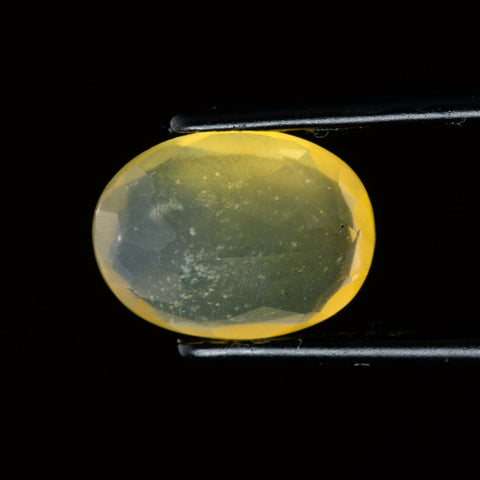
Opals can come in a variety of colours, including yellow. The shades of yellow opal usually range from just a slight tinge to deep gold. The stones are opaque to translucent but can exhibit opalescence, producing a gentle glow and shifting colours depending on lighting and viewing angle.
Yellow Opal is highly regarded in yellow healing practices for its ability to promote emotional balance and positivity.
Yellow Orthoclase
Yellow orthoclase generally comes from Madagascar and is a transparent yellow variety of sanidine, usually ranging from light champagne to mid-toned yellow. It’s called yellow orthoclase because it was originally thought to be orthoclase. While further analysis showed it was sanidine, the name already stuck.
Yellow Prehnite
Prehnite can come in shades of green, blue-green, and yellow, and it’s even transparent at times, though that’s rare. Versions that are yellow-green and translucent are often faceted to highlight the striking colouring, though yellow prehnite is also widely used for cabochons. Cabochons are particularly popular for certain specimens, as yellow prehnite can exhibit a cat’s-eye effect.
Yellow Sapphire

Yellow sapphire is part of the corundum family of minerals, and it can range in colour from lemon to honey due to the presence of iron or titanium. Yellow sapphires are highly durable, making them suitable for daily wear. Since yellow sapphire is typically transparent, faceting the stone is most common.
Yellow sapphire is also renowned as a yellow healing stone, believed to aid physical health issues related to the liver, gallbladder, and reproductive system, and to promote mental clarity, wisdom, and positive energy. Yellow sapphire can be carried or worn to harness its benefits for energetic protection and manifestation.
Yellow Scapolite

Scapolite is known for its excellent transparency and comes in a variety of colours. Yellow scapolite can be a relatively true yellow, though it may also lean slightly green or be a little earthy, making it appear golden. Yellow scapolite is usually faceted for jewelry to showcase its transparency and fire.
Yellow Selenite

Yellow selenite is part of the gypsum family and can form in striking crystal clusters. The colour is usually lemony or slightly golden, and the stones are commonly transparent, with some being translucent. Since it can have inclusions, it’s often turned into beads or cabochons, though some high-quality pieces are sometimes faceted.
Yellow Serpentine
Yellow serpentine is a silicate mineral, and it’s typically a bit on the softer side, ranging from 3 to 6 on the Mohs hardness scale. Overall, yellow serpentine is usually opaque and typically has a slightly earthy or green tinge to its colouring. Mottling, banding, or other patterning is also common, usually in sections ranging from light gray to deep gray or green.
Yellow Sillimanite
Sillimanite comes in three colours, including yellow. Yellow sillimanite is rare and difficult to cut, so it’s not widely seen in jewelry. The stone can range from opaque to transparent. With some transparent pieces, the gemstone contains thin fibres, giving it a silky look when faceted.
Yellow Smithsonite

Smithsonite is a near-opaque to translucent gem that can come in various colours. When cadmium is present, it often ends up a striking yellow. Yellow smithsonite is a softer stone, measuring between 4 and 5 on the Mohs hardness scale. As a result, it’s more commonly treated as a collector’s stone instead of being used for jewelry.
Yellow Sphalerite

Yellow sphalerite – also referred to as golden sphalerite – is a yellow-orange gemstone with an earthy tinge. Iron usually plays a role in the colouring, with higher iron levels making the stone darker. The stone is generally translucent to transparent and often has a resinous to diamond-like lustre. The colouring can also be slightly mottled, causing the gem to exhibit several hues when faceted.
Yellow Sphene
Sphene is a calcium-titanium silicate mineral. It can come in a variety of shades, including yellow. Generally, sphene is known for fire that rivals that of diamonds, and some specimens also exhibit pleochroism. One issue is that sphene is relatively soft, with a hardness of only 5 to 5.5 on the Mohs scale, so it’s not ideal for everyday wear.
Yellow Spinel
Spinel – an oxide mineral – comes in a variety of colours. The presence of iron or magnesium can cause a yellow hue. Yellow spinel is highly durable, often rating near an 8 on the Mohs hardness scale. Additionally, it has high clarity and transparency, with a brilliance not unlike that of ruby or sapphire.
Yellow (Honey) Topaz

Yellow topaz – also known as honey topaz – offers excellent fire and high transparency, making it suitable for faceting. The exact shade is usually a touch warm or earthy, creating a sense of depth. Topaz is also known for durability, so it’s suitable for everyday wear. Golden topaz is associated with attracting good fortune, manifesting goals, and enhancing confidence, making it a popular choice for those seeking positive changes and success.
Yellow Tourmaline

Tourmaline comes in many colours, including yellow tourmaline. Generally, yellow tourmaline is any tourmaline gemstone ranging from delicate champagne to vibrant gold, with particularly bright versions often called canary tourmaline. Many are faceted for jewelry, as they’re durable stones. However, some may be cut as cabochons if they exhibit the cat’s-eye effect.
Yellow Tourmaline is also known for attracting abundance and prosperity, making it a popular choice for those seeking to improve their financial situation. Additionally, it is believed to remove or deflect negative energy, promoting healing and clarity.
We work with tourmaline extensively — it appears in several of our most-loved designs. While our tourmaline pieces tend toward the pink and green ends of the spectrum, tourmaline’s golden-yellow varieties are among the most wearable in jewellery. Our Fierce Fire Element Set ($109) features warm-toned tourmaline alongside carnelian and citrine in a bracelet stack that beautifully captures the warmth of this stone family.
Yellow Turquoise
While yellow turquoise is a genuine stone, it’s not technically turquoise. Instead, it’s typically jasper or serpentine with a hematite matrix that resembles the patterns you see in turquoise. Additionally, yellow turquoise is usually a dyed stone, allowing it to achieve a richer yellow colouring.
Yellow Vesuvianite

Also known as idocrase, vesuvianite is a gemstone that forms in crystals, and it comes in several colours, with yellow being one variety. Typically, the yellow versions are a bit earthy or are tinged green. The stone usually falls between 6.5 and 7 on the Mohs hardness scale, so it’s reasonably durable. They also vary from translucent to transparent and can have a glassy or oily lustre.
Yellow Wulfenite
Yellow wulfenite is usually translucent and can range from bright yellow to orange-yellow. Generally, it’s resinous or waxy, and it’s incredibly soft, usually only scoring a 3 on the Mohs hardness scale. As a result, it’s not widely used in jewelry. Instead, crystal formations are often collector’s pieces.
Yellow Zircon

With yellow zircon, you get a durable stone that ranges in colour from champagne to a strong yellow, with a potential golden tinge. Yellow Zircon is traditionally transparent, so it works well for faceting. It typically ranks 7.5 on the Mohs hardness scale, so it’s durable enough for daily wear.
Yellow Zoisite

Zoisite is a mineral class with several varieties. Yellow zoisite is a rarer version, and it’s occasionally referred to as yellow tanzanite since tanzanite is also a zoisite mineral. Typically, the yellow colouring is lighter and may lean slightly green. Yellow zoisite often exhibits strong transparency and clarity and is durable enough for use in jewelry.
Yellow and golden gemstones span an extraordinary range — from the abundant warmth of citrine to the geological rarity of yellow taaffeite. What unites them is their connection to light, energy, and optimism. Whether you're drawn to their metaphysical properties, their visual warmth, or simply the way a golden stone catches the afternoon light, this colour family has something for everyone.
At Fierce Lynx, we design with citrine, tiger eye, sunstone, and warm-toned jasper year-round. Browse our current collection →


