

Are you curious about man-made crystals and their role in modern jewelry and ethical consumerism? This comprehensive guide is designed for jewelry enthusiasts, ethical consumers, and anyone interested in the world of synthetic gemstones. In this article, we’ll cover 8 popular types of man-made crystals, exploring their unique properties, uses, and the reasons they matter in today’s marketplace.
Man-made crystals—also known as synthetic crystals—are gemstones that are produced in a laboratory or industrial setting. These synthetic crystals are chemically identical to their natural counterparts, meaning they share the same chemical composition, optical, and physical characteristics as naturally occurring stones. The term "man-made" refers to crystals created through controlled processes in a lab or industrial environment, rather than being mined from the earth.
Why does this topic matter? Man-made crystals offer several compelling advantages: they are often more affordable than natural stones, present a more ethical alternative by avoiding the environmental and social issues associated with mining, and provide a sustainable option for those seeking to minimize their ecological footprint. Additionally, synthetic crystals are typically free from the inclusions and imperfections found in natural stones, making them especially appealing to those seeking clarity and uniformity in appearance.
Synthetic gemstones, which can range from synthetic rubies to emeralds and lab-grown gems, offer an intriguing alternative to natural stones and crystals. Created in laboratories through meticulous processes that replicate the conditions under which natural crystals and gems naturally develop, these stones boast the same chemical and physical attributes as their mined counterparts.
Lab-grown gems not only mirror the chemical composition, optical, and physical characteristics of natural gemstones but also present a cost-effective and ethically superior alternative to natural gems, which often require treatment and enhancement to improve their quality. Known for their clarity and uniformity, synthetic gems are often free of the inclusions found in natural stones, which can be appealing to consumers seeking perfection in appearance.
By adopting methods such as the Verneuil process or hydrothermal growth, scientists can produce these gemstones in a fraction of the time it takes nature to form a similar crystal structure. The reason for creating synthetic stones isn’t purely aesthetic; it also addresses ethical concerns and accessibility, and offers a more affordable price point.
Gemologists use advanced techniques to distinguish between natural and synthetic gemstones, ensuring transparency in the marketplace. Despite being laboratory-grown, these stones meet the high standards of gemology; the aluminum oxide crystals in synthetic sapphires are just as hard as those in natural sapphires and share identical optical properties with gems found deep within the earth.
Let’s explore some of the most popular types of man-made crystals and gemstones.
8 Popular Manufactured Stones
1. Composite Stones

Composite stones incorporate chips and remnants of natural gemstones bonded with a binding agent, often resin. They are known for their vibrant colours, and when those colours appear overly intense, it may indicate that the crystals were dyed or treated with dye. On close inspection, these stones may also show pooled dye in pores or visible banding. Reconstituted stone beads and cabochons are commonly crafted from this eclectic material.
Shop our Manufactured and Up-cycled Stone Jewelry Collection
2. Goldstone

Goldstone, a type of glittering glass, gets its characteristic sparkle from copper crystals embedded within it. Originating in a reddish-brown hue, variations such as blue and green are produced using cobalt or chromium, respectively. Associated with ambition and confidence, goldstone is popular in beads and cabochon forms.
3. Opalite and Synthetic Opal

Opalite exists in two forms: one is a natural occurrence of hydrated silica, while the other is manufactured, typically from glass. It can also be crafted from resin or plastic. Manufactured opalite is especially valued for its glassy appearance and is associated with communication and strength.
4. Fordite

Fordite, also known as Detroit agate or motor agate, is composed of hardened layers of automotive paint. Its colourful and historical nature is revered and sought after in the form of jewelry such as beads or cabochons.
5. Mosaic Quartz

Mosaic quartz combines quartz fragments with dyed or treated resin to enhance colour and create unique patterns. Mosaic Quartz can include both natural and synthetic quartz crystals, providing a unique blend of materials. This versatile stone is sometimes combined with materials like mica powder to add lustre, making each piece distinctly beautiful. Additionally, mosaic quartz can include synthetic quartz, crafted through hydrothermal growth, in which dissolved nutrients form artificial crystals.
6. Terra Agate

Terra agate, a naturally occurring stone, undergoes enhancement processes to intensify its colour palette, often featuring a blend of earthy tones with brilliant blues or greens. The agate's patterning is sometimes augmented through laser etching or sanding, showcasing the stone's depth.
7. Impression Jasper

Impression Jasper, not true Jasper, conversely, contains variscite that may be dyed for more vivid colouring. Resin is the typical binder, resulting in products such as beads and cabochons. Renamed Aqua Terra Jasper, it features natural materials like marble, whose colours are accentuated through dyeing processes.
8. Cubic Zirconia
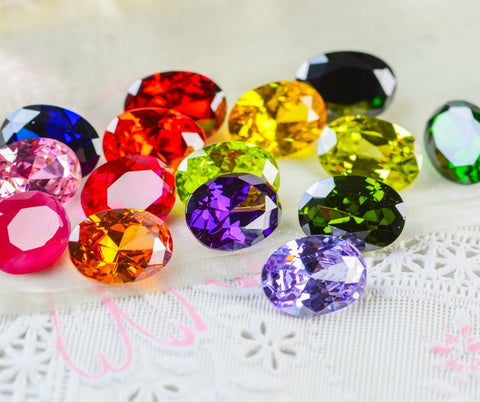
Cubic Zirconia (CZ) is a synthetic gemstone that closely resembles diamonds due to its brilliance and crystal clarity. Synthetic gemstones offer several environmental benefits over their natural mineral counterparts. It was first developed in the 1970s and is made from zirconium dioxide. This gemstone is a popular and affordable alternative to diamonds for several reasons:
Synthetic sapphire is another popular synthetic gemstone. In terms of its optical properties and manufacturing process, synthetic sapphire is similar to cubic zirconia, showcasing the diversity of synthetic gemstone options available.
-
Appearance: Cubic zirconia can be made virtually flawless and is usually colourless, although it can be produced in a variety of different colours.
-
Hardness: It has a hardness of 8.5 on the Mohs scale, which is considerably hard, though less than diamonds, which score a 10.
-
Optical Properties: While it exhibits impressive fire and brilliance, CZ has a higher dispersion rate compared to diamonds, resulting in more “fire,” which is the flashes of rainbow colours that can be seen in well-cut stones.
-
Cost and Versatility: Due to its low cost, cubic zirconia is widely used in jewelry, enabling bold, glamorous designs without the same financial commitment as diamonds.
Despite its many diamond-like qualities, cubic zirconia is less durable and will wear down more quickly than a diamond. It’s also slightly denser, meaning it will feel heavier than a diamond of the same size. Over time, cubic zirconia can become cloudy from everyday wear unless it is properly maintained.
Beyond their beauty and variety, man-made crystals offer significant environmental advantages.
Environmental Benefits of Lab-Created Gemstones Compared to Their Natural Counterparts
Synthetic gemstones offer several environmental benefits over their natural counterparts, primarily due to the controlled laboratory processes used to create them. Beyond the jewelry industry, synthetic crystals are also used in lasers, watchmaking, and microelectronics, highlighting their broader industrial applications. Here are some of the key environmental advantages:
-
Reduced Environmental Degradation: Natural gemstone mining can be highly destructive to the environment, involving extensive earth movement, deforestation, and habitat disruption. In contrast, synthetic gemstones are produced in laboratories, significantly reducing the environmental impact associated with traditional mining practices.
-
Lower Water Usage: Mining operations often require large quantities of water, which can deplete local water supplies and contribute to environmental degradation. Laboratory production of synthetic gemstones uses considerably less water, helping preserve vital water resources.
-
Decreased Carbon Footprint: The carbon footprint of mining includes heavy machinery operations, material transportation, and other energy-intensive processes. Synthetic gemstone production typically requires less energy, particularly if renewable energy sources power the laboratories.
-
Waste Reduction: Mining can produce substantial waste, including tailings and other byproducts that can be hazardous to the environment. The processes for creating synthetic gemstones generate far less waste, and the waste that is produced is often more manageable and less toxic.
-
Avoidance of Conflict Mining: Many natural gemstones are sourced from conflict zones where mining practices may fund armed conflict and human rights abuses. Synthetic gemstones offer a conflict-free alternative, allowing consumers to select ethically sourced gems without contributing to geopolitical tensions.
-
Promotion of Biodiversity: Synthetic gemstone production helps preserve biodiversity by reducing the need to disturb natural landscapes. This is particularly important in ecologically sensitive areas where mining activities might threaten unique plant and animal species.
These environmental benefits make synthetic gemstones an attractive choice for environmentally conscious consumers who prefer to make ethical and sustainable purchasing decisions.
Frequently Asked Questions
How can one discern if a gemstone is synthetic?
To determine if a gemstone is synthetic, specialized equipment and expertise may be required, and accurate disclosure matters for stones such as natural amethyst, as well as treated or lab-created gems. In the U.S., the Federal Trade Commission mandates clear disclosure of synthetic gems to prevent deceptive marketing. Here are some common methods:
-
Visual inspection: Professionals may look for unique inclusions from organic formation, or other internal patterns typical of natural crystals, while synthetic stones may show different internal features under a microscope.
-
Refractive Index: By measuring how light bends when passing through the gem, experts can distinguish between natural and synthetic gems.
-
Specific gravity: The gemstone's density can provide clues to its origins.
-
Spectroscopy: Examining the absorbed or emitted light spectra can reveal the stone's chemical composition.
What factors influence the value of synthetic gemstones?
Several factors impact the value of synthetic gemstones:
-
Quality: The clarity, cut, and colour of the gemstone.
-
Size: Larger stones typically demand higher prices.
-
Production cost: The complexity of the manufacturing process.
-
Market demand: Rarity and popularity among consumers.
-
Branding: Gems from renowned labs can be more valuable.
Which types of synthetic gemstones are commonly found in jewellery?
Commonly found synthetic gemstones in jewellery include:
-
Synthetic Diamonds: Made using High Pressure High Temperature (HPHT) or chemical vapour deposition (CVD), which is used for lab-grown diamonds. Synthetic diamonds can be about 20–80% cheaper than natural diamonds.
-
Lab-created Ruby and Sapphire: Both are forms of corundum, and the Verneuil process is a classic method for producing gems such as synthetic ruby and sapphire.
-
Synthetic opal: Known for the colourful play-of-light.
-
Cultured pearls: Produced by molluscs in controlled environments.
-
Synthetic corundum: Produced using flame fusion or flux growth processes, used in various commercial applications.
-
Synthetic spinel: Often used as an imitation for other gemstones and in composite stones like doublets and triplets.
What distinguishes synthetic gems from natural ones?
Synthetic gems, also known as created gemstones, are manufactured in controlled environments, in contrast to natural gemstones that form over millions of years on Earth. Despite their different origins, synthetic and natural stone gems may have identical chemical and physical properties, highlighting the advanced technology used to replicate the characteristics of non-natural gems.
Can synthetic gemstones be considered real, and how do they differ from imitations?
Synthetic gemstones are real in that they have the same chemical composition as their natural counterparts. They differ from imitation gems, which only mimic the look and are made from different, often inferior, materials, while a natural gem is typically rarer and traditionally valued more highly because of its origin and scarcity.
What are the prevalent methods used in the creation of synthetic gemstones?
Crystal synthesis techniques generally fall into melt processes, solution growth, and vapour deposition, and some lab-grown crystals and enhanced stones are still believed to hold healing properties; many synthetic gemstones can be produced within weeks to a year.
Prevalent methods for creating synthetic gemstones include:
-
Flux-growth process: Slowly crystallizes gems from material dissolved in a chemical solution, the same way sugar dissolves in water, producing flux-grown stones.
-
Hydrothermal process: Mimics natural gemstone formation using high pressure and temperature in a water solution, recreating the high-pressure, high-temperature conditions found deep within the Earth.
-
CVD (Chemical Vapour Deposition): Used primarily for diamond growth, it begins on a seed inside a vacuum or growth chamber, where carbon atoms deposit layer by layer.
-
HPHT (High Pressure High Temperature): Mimics the conditions deep in the Earth to create diamonds; synthetic quartz became widely available after World War II and also found industrial applications.
-
Czochralski method: A crystal growth technique used to grow high-quality single crystals.
Bismuth is a man-made crystal formed from melted ingots and is often associated with focus and visualization.
In jewelry, citrine and other lab-grown crystals can also appear alongside treated materials; Aura Quartz starts with natural quartz or clear quartz and is bonded with precious metals and other minerals, with aqua aura and angel aura as examples, and Aura Quartz is said to enhance the properties of the original stone.
Treated examples can include enhanced stones such as heat-treated citrine, heat-treated smoky quartz, or other stones that may show more intense colour than natural ones, and these enhanced crystals are often still believed to retain the healing properties of natural stones.
Melt processes heat raw materials and form crystals as they cool. Clean treated pieces gently with mild soap and avoid harsh chemicals.


