

Unveiling the Diverse World of Garnets – A Comprehensive Guide to 9 Varieties
Garnet is a complex group of silicate minerals and gem garnets. Garnets, often synonymous with the deep red gemstone of January's birthstone, actually come in many types, each with unique properties and colours. This guide is for gemstone enthusiasts, jewelry buyers, and anyone interested in learning about the different types of garnet. Knowing the types of garnet helps you make informed choices when selecting gemstones for jewelry or collections. The six species of gem-quality garnets, which are also the main garnet varieties, are: almandine, pyrope, spessartine, grossular, andradite, and uvarovite.
There are six species of gem-quality garnets.
Below, you'll find a concise summary that directly answers the query "types of garnet":
-
The six species of gem-quality garnets are: almandine, pyrope, spessartine, grossular, andradite, and uvarovite.
Composition and Structure
Chemical Formula
-
The term garnet refers to a complex group of closely related minerals with a general chemical formula of X₃Y₂(SiO₄)₃, where X and Y are various metal ions. The diversity in the garnet group arises from the different combinations of these metal ions.
Crystal System
-
Garnets crystallize in the cubic system, typically forming dodecahedral or trapezohedral crystals. Their crystal structure is responsible for their characteristic shapes and high symmetry.
Now that we've covered the composition and structure of garnets, let's move on to their physical properties.
Physical Properties
Hardness
-
Garnets typically range from 6.5 to 7.5 on the Mohs scale, making them durable enough for various types of jewelry.
Refractive Index
-
They generally have a high refractive index, contributing to their brilliant sparkle.
Lustre
-
Garnets typically have a vitreous (glass-like) lustre.
Cleavage
-
Garnets lack cleavage, which means they do not break along defined planes and are more resistant to fracturing.
Crystal System
-
Garnet crystals form in the cubic crystal system.
Chemical Formula
-
Garnets share a general formula of X3Y2(SiO4)3, with the most common species including aluminum or calcium silicates; aluminum silicate garnets are known as the Pyralspite Group, and metal-ion substitutions can include magnesium, manganese, and ferrous iron.
Colour Range
-
Garnets are renowned for their extensive colour range, covering almost every colour, including red, orange, yellow, green, purple, brown, black, and even colourless, with some specimens appearing nearly colourless when chromophore-causing impurities are absent. The colour is often influenced by trace elements such as iron, chromium, and manganese.
Now that we've covered the physical characteristics of garnets, let's explore their symbolism and uses.
Symbolism and Uses
Historical Significance
-
Garnets have been used for thousands of years. They were popular in ancient Egypt, Rome, and among the Saxons and Vikings.
Symbolism
-
They are often associated with love, friendship, light, and vitality.
Uses
-
Beyond jewelry, garnets are used in industrial settings for cutting and sanding.
With an understanding of garnet's symbolism and uses, let's look at how to care for and maintain these beautiful gemstones.
Care and Maintenance
Cleaning
-
They should be cleaned with warm, soapy water and a soft brush. Most gem-quality garnets do not fade or discolour under normal use, but it's generally advisable to avoid ultrasonic and steam cleaners.
Handling
-
While relatively hardy, they should be protected from sharp blows and extreme temperature changes, since careless handling can damage valuable garnet gemstones.
Now that you know how to care for garnets, let's consider their ethical and sustainable aspects.
Ethical and Sustainable Aspects
Sourcing
-
Knowing where your garnets come from can help ensure they are sourced ethically. Some garnet mining practices are more sustainable and ethical than others, and deposits can also occur in metamorphic rocks such as mica schist.
Understanding the ethical and sustainable aspects of garnet sourcing can help you make responsible choices. Next, let's dive into the specific types of garnet you should know.
9 Types of Garnet You Should Know
1. Grossular Garnet: A Spectrum of Nature's Best
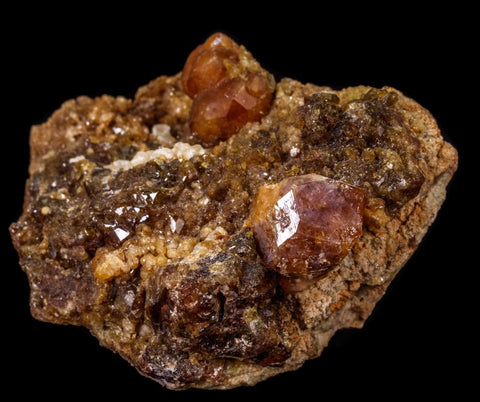
Grossular garnet is technically a group that features several varieties of garnet covering various colours. There are colourless varieties and green, yellow, orange, red, brown, and black varieties. Sometimes, a variety of grossular garnets may be gray, and some are considered white.
Several green garnet types are in the grossular group, including green grossular, with tsavorite being the best-known garnet variety. For warmer colouring, hessonite is usually the most widely known, particularly the golden-orange and cinnamon-brown versions of this grossular variety.
The Mali garnet is the most recent discovery within the group, initially found in 1994. It's exceptionally rare and has yellow colouring with hints of light green, giving it a sense of play-of-colour when properly faceted.
Another incredibly rare version is the Leuco garnet. It's a colourless version that can resemble a diamond, depending on the clarity. Some versions are also gently tinted, giving the stone a hint of yellow or green.
2. Hessonite: The Reddish Orange Garnet species

Nicknamed the “cinnamon stone,” hessonite is an orange-brown variety of grossular garnet with an earthier hue. These garnet stones' colours range from goldenrod to red, with some orange-red versions having brown tints.
Usually, vibrant golden-orange hessonite garnet gemstones are the most popular. They often look like honey, though an internal fire shines orange. Additionally, a high-clarity hessonite garnet is preferred, as those with inclusions can appear muddy or oily. In some gemstone traditions, it may be discussed alongside topaz as a similarly warm-toned stone, though hessonite is typically distinguished by its cinnamon-like body colour.
As with most other garnets, high-quality versions are typically faceted. However, those with inclusions may be cut as cabochons instead. Hessonite garnet is one of the nine planetary gemstones in Vedic astrology.
3. Tsavorite Garnet: The Bright Green Gem

Tsavorite is a relatively new discovery. The first ones weren't unearthed until 1967 and are exceptionally rare. In many cases, that makes tsavorite an expensive stone.
The tsavorite garnet is a grossular garnet by composition; it's simply a version found in a specific place: Tsavo National Park in Kenya. It's mined only in certain parts of East Africa and is prized in the gem world for its natural green colouring.
Green tsavorite contains chromium and vanadium, which give the stone its striking hue. Most specimens are a deeper green, though some are incredibly bright and vibrant. The latter versions are the most prized, but all types are popular.
This green garnet stone usually has excellent colouring and clarity. Plus, the lustre is often exceptional. As a result, it's most commonly faceted when used in jewelry.
4. Umbalite Garnet
One of the rarer garnets, umbalite, comes in various hues. Initially discovered in the 1960s, the umbalite garnet most commonly comes in shades of red, purple, pink, and brown, though some may lean toward yellow or orange.
When it comes to one of the most desirable colours of umbalite, blue versions are available. Blue garnets are the rarest variety and were first reported in the 1990s, making this example exceptionally rare. Generally speaking, it's a teal blue garnet gemstone. Depending on the lighting, this color change garnet can shift from teal blue to green, which is the prized effect.
Umbalite garnet is usually faceted because it has high clarity and good fire. However, if found with rutile crystal inclusions, it may be turned into a cabochon to capture a cat's eye effect.
5. Spessartite Garnet

Spessartite – also called spessartine by some – is a striking garnet first discovered in Germany. It's known for its bright orange colouring, a shade that often resembles a pumpkin. While some versions lean more toward yellow or red, and some have a brownish tint, most people who want a spessartite garnet are after the orange shade.
The most popular orange spessartite garnet is occasionally called Mandarin garnet, which is technically a tradename. Usually, those stones have the most vibrant orange colouring, bright enough that some refer to the hue as electric orange.
Spessartite garnets with high degrees of clarity are usually faceted. However, those with fibrous inclusions may become cabochons, as the inclusions can create a cat's eye effect. Some Spessartite garnets can even change colour.
6. Rhodolite

Another rare garnet species, rhodolite, stands out due to its unique hue and is a hybrid of pyrope and almandine. While the colours of garnet usually fall in the red or green family, rhodolite is a pink garnet. It leans pink, rose, purple, or violet, with many versions being a shade close to raspberry.
Along with intriguing colouring and solid clarity, rhodolite garnet is tough. That makes it suitable for everyday wear, which is excellent if you're looking for jewelry stones. Its high dispersion creates a breathtaking fire, too, which is why most rhodolite garnet is faceted if it's gem-quality.
In some cases, rhodolite may contain rutile crystals. When that happens, the piece can have a cat's eye effect. Those gems are usually turned into cabochons to highlight that unique characteristic.
7. Almandine

Almandine garnets are among the most common species on this list, so they're highly accessible, and they are also one of the classic red garnets. They usually contain less iron and more magnesium, resulting in a deep, rich red colouring. However, almandine garnet can sometimes be black, resulting in an incredibly striking gemstone. It may also exhibit hints of purple or brown, and unlike some other varieties, red garnets are usually eye-clean and have fewer visible inclusions.
While almandine is faceted when the stone offers sufficient clarity, it's also frequently cut as a cabochon. The almandine gem is called a carbuncle when shaped in that fashion. Star garnet can occur in almandine and is usually cut en cabochon.
In most cases, almandine is an inexpensive garnet, making it perfect for budget-conscious buyers. However, large gem-quality crystals with high degrees of clarity are less common than ordinary material, so fine almandine pieces can be costly.
8. Pyrope

Of all the types of garnet gemstones, pyrope is the only one that's practically always red in natural specimens, with red pyrope showing the classic colour most people expect. The red can range from incredibly vibrant to deep dark red – depending on its precise chemical composition – and often resembles a ruby, which makes it highly desirable.
Its name comes from a Greek word meaning “fire-eyed,” a nod to its fiery appearance.
There are rare cases where a piece of pyrope ends up colourless. When this occurs, it's an incredibly valuable version of the stone, primarily because such a specimen isn't found often.
Pyrope also typically has exceptional clarity. It rarely has flaws or inclusions, giving it high transparency. Red garnets like pyrope are often eye-clean and have fewer visible inclusions. As a result, pyrope is frequently faceted, though cabochons are also common. Star garnets display asterism due to needle-like rutile inclusions, while pyrope forms under high-pressure conditions.
9. Demantoid Garnet

The demantoid garnet is the rarest and most expensive garnet. First discovered in the 1860s, it is a variety of andradite. Typically, the demantoid garnet stone colour is a lighter green, often having hints of yellow or brown. However, the pure green versions are the most highly coveted, making them the most valuable overall.
Generally, the shade of green is a tad less vibrant than that of peridot. Some may describe it as minty. Others may consider it closer to spring green. When there's more yellow, it can be a more delicate version of lime, while it may look a bit sage-toned if there are hints of brown.
In some cases, fibrous inclusions form in a "horsetail" configuration. While inclusions usually don't boost a stone's value, this horsetail increases the price of demantoid garnet. As an andradite garnet, it is also more prone to scratching and breaking than some other garnets.
Now that you know about the nine most fascinating types of garnet, let's organize this information with a handy cheat sheet for quick reference.
Cheat Sheet: Main Types and Garnet Species
There are six species of gem-quality garnets.
Below, you'll find the main types and species of garnet, broken down for clarity:
Almandine
-
Colour: Deep red to reddish-brown, often with a tinge of violet.
-
Characteristics: Most common type; usually eye-clean; can be faceted or cut as a cabochon (carbuncle); star garnet can occur.
Pyrope
-
Colour: Vivid red, often without brownish or orange tones.
-
Characteristics: Known for transparency and clarity; rarely has inclusions; can be colourless in rare cases.
Spessartine (Spessartite)
-
Colour: Ranges from yellow to reddish-orange to orange-red.
-
Characteristics: Bright orange is most prized (Mandarin garnet); can show cat's eye effect if fibrous inclusions are present.
Grossular
-
Colour: Wide range—colourless, green (tsavorite), yellow, orange (hessonite), red, brown, black.
-
Characteristics: Includes tsavorite (bright green), hessonite (cinnamon orange), Mali garnet (yellow-green), and leuco garnet (colourless).
Andradite
-
Colour: Colourless, bright green (demantoid), yellow to green (topazolite), black or dark brown (melanite).
-
Characteristics: Demantoid is highly prized for brilliance and horsetail inclusions; more prone to scratching.
Uvarovite
-
Colour: Bright green, usually small crystals.
-
Characteristics: Rare; typically found as druzy crystals rather than faceted stones.
Now that you have a quick reference for the main types of garnet, let's address some frequently asked questions.
Frequently Asked Questions About The Garnet Family
Is a garnet expensive?
-
Variability in Price: Garnet prices vary widely depending on the type, size, colour, and quality. Some types, like Almandine, are relatively affordable, while others, like Demantoid and Tsavorite, can be quite expensive.
-
Factors Affecting Price:
-
Rarity
-
Colour intensity
-
Clarity
-
Cut
-
Carat
-
Who should not wear garnet?
-
Astrological Beliefs: In astrology, it's believed that certain gemstones may not be suitable for everyone, depending on their zodiac or other astrological factors. However, these beliefs are not scientifically backed.
-
Practical Considerations: People with active lifestyles or those who frequently work with their hands might want to consider the durability of garnet (especially softer varieties) in their jewelry.
What is the rarest colour of garnet?
-
Blue Garnet: The rarest colour of garnet is blue, which changes colour from blue-green in daylight to purplish-red under incandescent light. This type is extremely rare and valuable.
How can I tell what type of garnet I have?
-
Professional Assessment: The most accurate way is to have it evaluated by a gemologist, who can help determine the garnet type.
-
DIY Methods:
-
Make an educated guess based on colour and transparency.
-
Identification often requires testing an individual gem rather than relying on colour alone.
-
For instance, if it's a vibrant green, it could be a Tsavorite or Demantoid.
-
What is the difference between almandine and pyrope garnet?
-
Almandine: Typically deep red to reddish-brown, often with a tinge of violet. It's the most common type of garnet.
-
Pyrope: Known for its transparency and vivid red colour, often without any brownish or orange tone; in comparisons of pyrope and almandine, this species is usually the clearer, purer red of the two.
How can you tell if a garnet is grossular?
-
Colour Range: Grossular garnets range from colourless to yellow, golden, orange, scarlet, and green. The green variety (Tsavorite) is particularly prized.
-
Transparency and Lustre: Grossular garnets often have a vitreous lustre and can be transparent to translucent.
Is tsavorite more rare than emerald?
-
Rarity: Tsavorite is rarer than emerald. It's found in fewer locations, and its deposits are usually smaller.
-
Comparison: Despite its rarity, tsavorite is often less expensive than emerald due to lower demand and less historical significance.
What is the difference between spessartite and spessartine?
-
Terminology: "Spessartite" and "Spessartine" refer to the same type of garnet. The terms are used interchangeably in the gemstone industry.
Summary:
Garnet is a complex group of silicate minerals with six species of gem-quality garnets: almandine, pyrope, spessartine, grossular, andradite, and uvarovite. Understanding the types of garnet helps you make informed choices for jewelry, collections, and ethical sourcing. Whether you're a gemstone enthusiast or a jewelry buyer, knowing the differences between garnet types ensures you select the perfect stone for your needs.


